Researchers Develop Multi-GPU Implementation for Large-Scale Quantum Chemistry Calculations
Scientists have created a multi-GPU implementation of MBE(3)-OSV-MP2, a quantum chemistry method that accelerates ab initio calculations for large molecular systems. The approach addresses key computational bottlenecks in local correlation theory by optimizing GPU parallelization across multiple aspects of the calculation. This advancement enables fast quantum chemistry simulations on macromolecules, potentially accelerating drug discovery and materials science research.
Researchers have developed a multi-GPU implementation of orbital-invariant local correlation methods, specifically third-order many-body expansion orbital-specific virtual MP2 (MBE(3)-OSV-MP2), to accelerate large-scale quantum chemistry calculations. The work addresses longstanding challenges in GPU parallelization of local correlation theories by optimizing several computational components: Jacobi-Plesset-Mezey localization, randomized orbital-specific virtual generation, direct MP2 integral regeneration, and CUDA kernel adaptation. The implementation achieves near-linear scaling with system size (O(N^1.9)) and 84% parallel efficiency across 24 GPUs on distributed nodes. Benchmark tests demonstrate 40-fold speedup compared to canonical RI-MP2 and 10-fold speedup over CPU-based implementations for water clusters, with a 784-atom insulin peptide calculation completing in 24 minutes using double-zeta basis sets. This advancement opens new computational possibilities for quantum chemistry simulations on real biological macromolecules.
Limitations & open questions
The study does not discuss potential limitations of the MBE(3)-OSV-MP2 method itself (e.g., accuracy trade-offs compared to higher-order methods), computational memory requirements for the GPU implementation, or how results compare to experimental data for validation purposes.
What different sources said
- arXiv physicsCenter
Multi-GPU MBE(3)-OSV-MP2 for Performant Large-Scale ab initio Calculations
Related
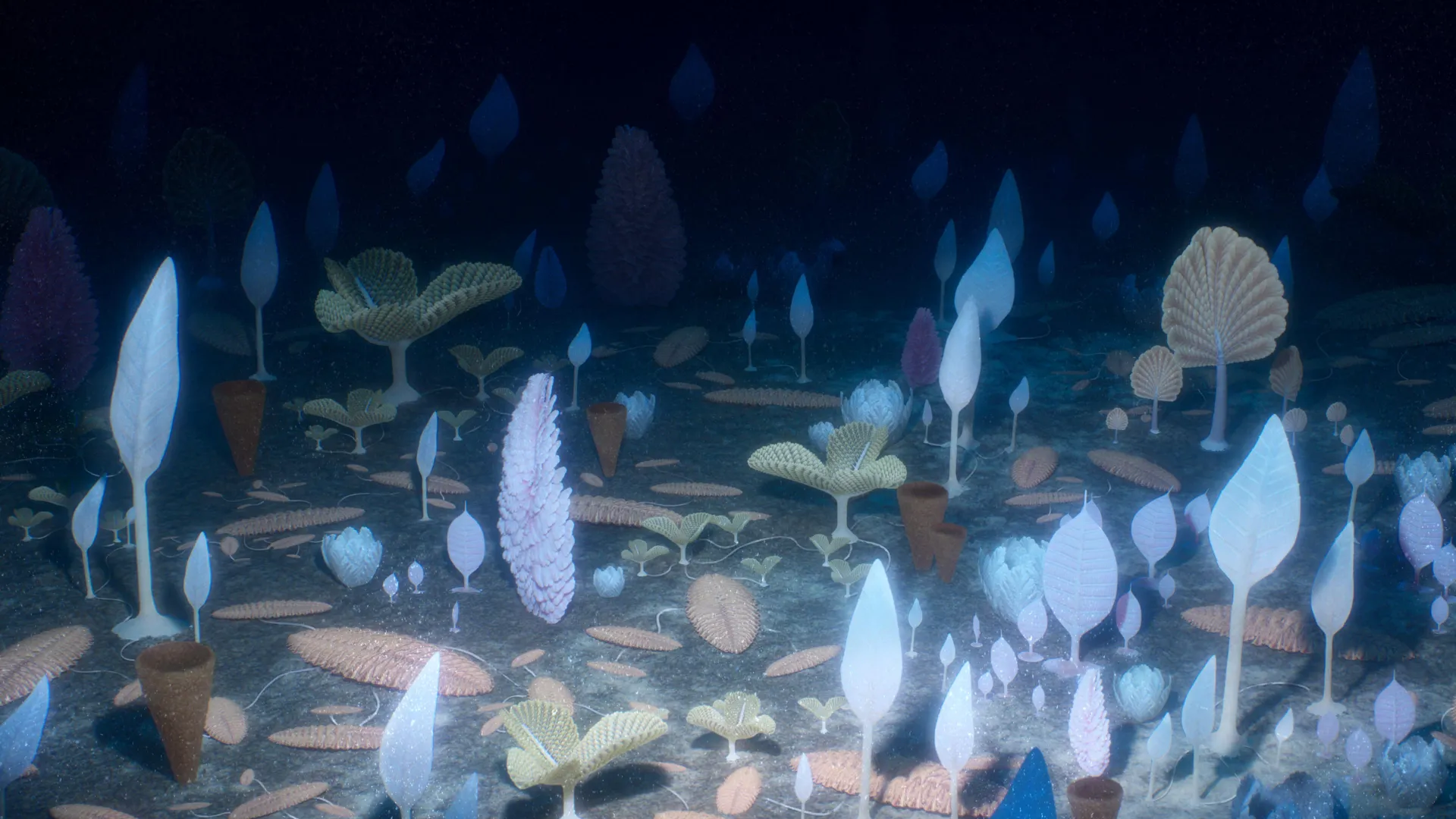
Study suggests asexual reproduction slowed early animal evolution during Ediacaran period
Researchers from the University of Cambridge found that early animals during the Ediacaran period (635-539 million years ago) reproduced asexually through runners, which limited competition and slowed evolutionary diversity. The study used fossil analysis, spatial modeling, and artificial intelligence to examine ancient ecosystems at Mistaken Point in Newfoundland. The findings help explain why animal diversity remained limited for millions of years before a dramatic burst of innovation in the Cambrian period.

UK Science Facilities Face £162m Funding Crisis With Potential Closures
Britain's world-leading science facilities, including the Diamond Light Source and ISIS Neutron and Muon Source, face potential closure or significant cuts due to a £162m funding crisis at the Science and Technology Facilities Council caused by rising electricity costs, staff expenses, and foreign exchange pressures. These facilities serve hundreds of companies and thousands of scientists domestically and internationally, with Diamond producing light 10 billion times brighter than the sun for materials research. Scientists and research leaders warn that short-term funding cuts could cause decades-long damage to the UK's scientific capability and international competitiveness.
Mitochondrial ROS Signaling Drives Avoidance Learning in C. elegans
Researchers discovered that reactive oxygen species (ROS) produced by mitochondria in postsynaptic neurons are necessary and sufficient to drive avoidance learning in C. elegans, using optogenetic stimulation of nociceptive neurons. The study demonstrates that activity-dependent mitochondrial ROS production increases glutamate receptors at synapses and strengthens neural circuits controlling avoidance behavior. This finding reveals a novel molecular mechanism linking neuronal activity to synaptic plasticity and behavioral learning.