India Stock Fund Inflows Hit Three-Year Low Amid Geopolitical Tensions
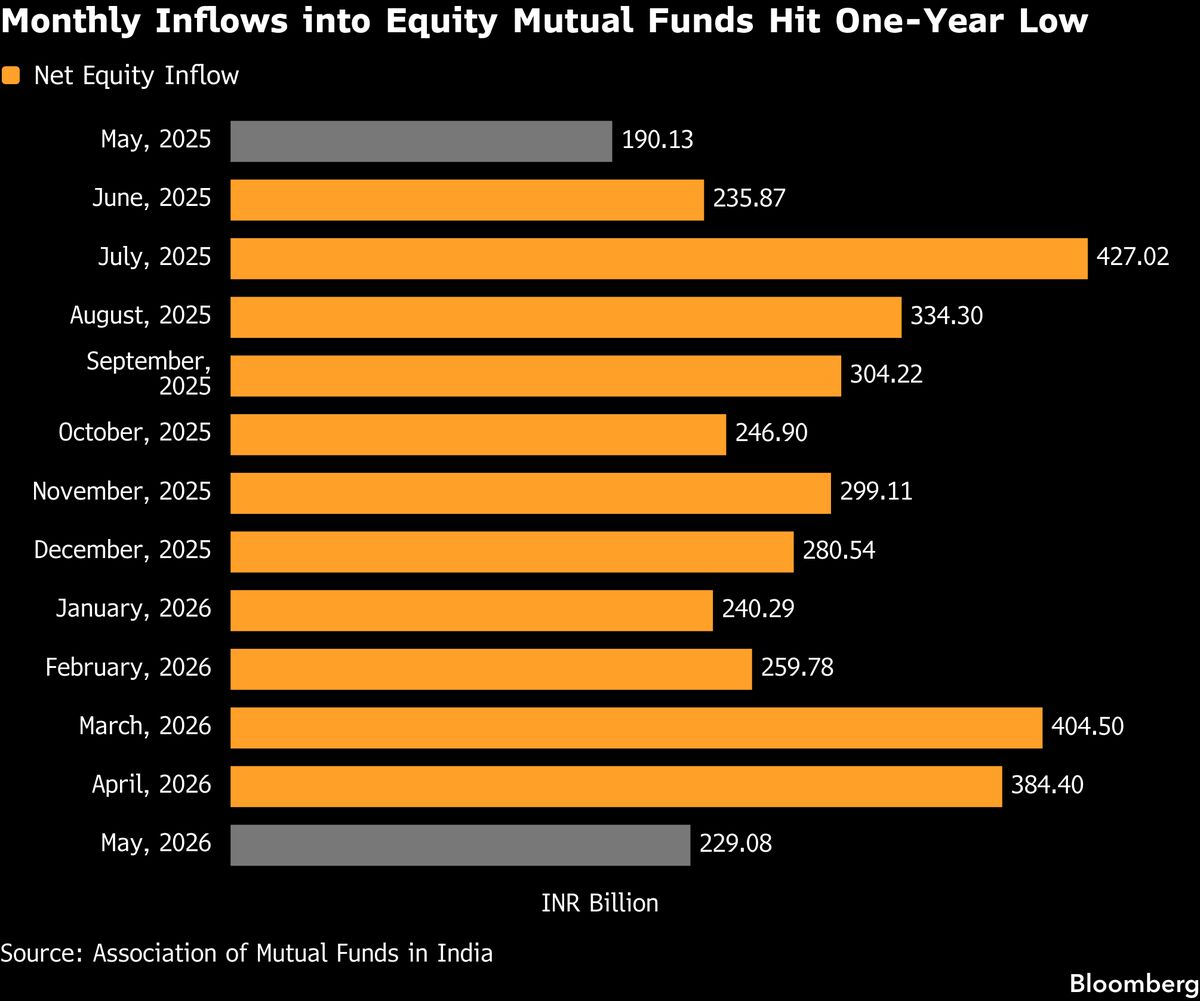
Net inflows into Indian equity mutual funds fell 40% month-on-month to Rs 22,908 crore in May 2026, down from Rs 38,440 crore in April, according to data from the Association of Mutual Funds in India (AMFI). The decline was driven by investor caution stemming from the prolonged US-Iran conflict, rising crude oil prices near $100 a barrel, and broader market volatility affecting India's energy-import-dependent economy. The broader mutual fund industry recorded net outflows of over Rs 64,000 crore in May, reversing April's inflows of Rs 3.22 lakh crore, though year-on-year equity inflows were still up 20% from May 2025.
Indian equity mutual fund inflows tumbled 40% in May 2026 to Rs 22,908 crore from Rs 38,440 crore in April, marking the lowest monthly equity inflow in a year, per AMFI data. The decline was broad-based: flexi-cap funds, the top category, saw inflows nearly halve to Rs 5,175 crore from Rs 10,148 crore; large-cap funds fell 37%; and mid-cap and small-cap funds dropped 33% and 28% respectively, though the latter two continued to attract sizeable inflows of Rs 4,385 crore and Rs 4,945 crore. Analysts attributed the slowdown to geopolitical uncertainty from the Iran-related conflict, crude oil prices hovering near $100 a barrel, and resulting market volatility. The broader industry swung to net outflows of Rs 64,004 crore in May from inflows of Rs 3.22 lakh crore in April, largely due to a sharp reversal in debt funds, which recorded outflows of Rs 96,949 crore after attracting Rs 2.47 lakh crore in April — a swing driven primarily by institutional withdrawals from liquid, money market, and overnight funds. Gold ETFs also slipped into outflow territory for the first time in 2026, recording net withdrawals of Rs 725 crore, attributed to profit-booking after a strong gold price rally. A key stabilising factor was systematic investment plan (SIP) contributions, which held relatively steady at Rs 30,954 crore in May versus Rs 31,115 crore in April, remaining above the Rs 30,000-crore mark for a third consecutive month and underscoring continued retail investor participation despite the broader slowdown.
Data: AMFI via Moneycontrol
What's missing
No source provides forward guidance or RBI commentary on how sustained crude oil prices near $100 might affect monetary policy, which is relevant to the outlook for both equity and debt fund flows.
How coverage differed
Bloomberg framed the story primarily through the lens of the US-Iran war's macroeconomic impact on India as an energy-import-dependent economy, while Indian outlets such as Times of India, Moneycontrol, and Economic Times provided granular AMFI data and included analyst commentary emphasising that the structural investment story remains intact, with SIPs and mid/small-cap inflows offering resilience.
What different sources said
- The Economic TimesCenter
AMFI Data: Equity mutual fund inflows tumble 40% to Rs 22,907 crore in May
- BloombergCenter
India Equity Fund Investors Turn Cautious as War Risks Grow
- Moneycontrol.comCenter
Flexi Cap inflows may have halved in May, but investors aren't abandoning the category as yet
- Times of IndiaCenter
Markets shake, money slows: Equity mutual funds see sharp dip in inflows
- Yahoo FinanceCenter
Retirees view market dips as a harbinger. Here's how to reassure them
Related

SpaceX IPO Makes Elon Musk World's First Trillionaire as Shares Surge 19% on Debut
SpaceX shares closed up 19% on their first trading day, pushing Elon Musk's net worth to approximately $1.11 trillion and making him the first individual in history to cross the trillion-dollar threshold. The company raised $75 billion at an IPO price of $135 per share, with shares closing near $161, giving SpaceX a market capitalization of roughly $2.1 trillion despite the company reporting a net loss of $4.94 billion in 2025. The milestone has drawn both investor enthusiasm and sharp criticism over Musk's social media conduct and concerns that the IPO's structure exploits passive index fund mechanics to extract wealth from ordinary retirement savers.
Delhi Power Bills to Rise for Some Consumers as Regulator Approves Higher Electricity Surcharge
Delhi's electricity regulator DERC has approved increased Power Purchase Adjustment Charges (PPAC) for distribution companies, raising bills for consumers in south, east, and central Delhi from July 2026. The hike follows a sharp rise in power procurement costs in April 2026, driven by higher summer demand and elevated fuel prices. The change also marks a structural shift from quarterly to monthly PPAC revisions, making electricity bills more responsive to real-time cost fluctuations.

SEC Proposes Repealing Rule 611 and Rule 610(e) of Regulation NMS
The Securities and Exchange Commission proposed on June 11, 2026, to rescind Rule 611 and Rule 610(e) of Regulation NMS, which govern trade-through protections and locking/crossing quotations in equity markets. Rule 611, in place for roughly two decades, requires trades to be executed at the best available price across exchanges. The proposal could reshape equity market structure and has implications for emerging areas such as tokenized stocks.