YouTuber Uses Custom Acoustic Scanner to Visualize Spatial Audio Performance in Different Speaker Setups
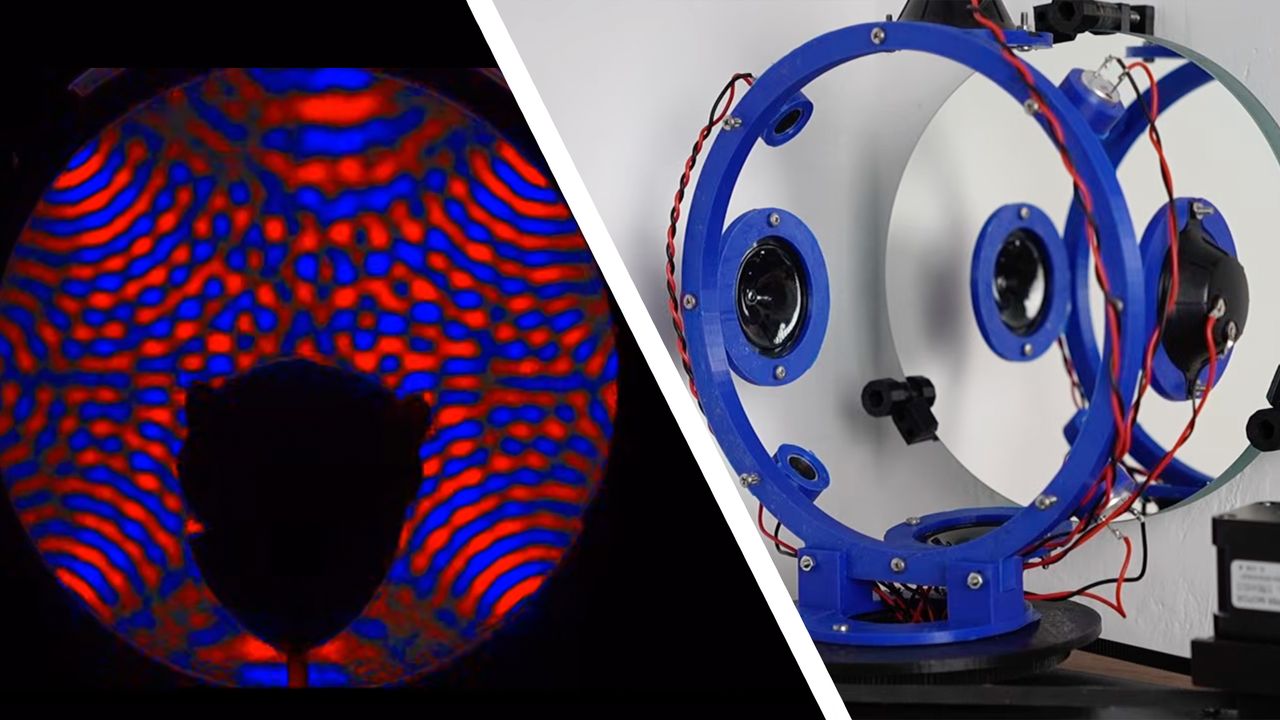
YouTuber PlasmatronX built a Computer Acoustic Tomography (CAT) scanner that visualizes sound waves in a room to compare how soundbars perform against full surround sound systems. The device uses multiple microphones and custom hardware to map acoustic behavior, with a stuffed guinea pig serving as a head-sized reference object. The visualization demonstrates how room acoustics and speaker placement affect spatial audio perception, revealing the 'sweet spots' for different audio configurations.
PlasmatronX created a custom testing rig that enables visual mapping of sound wave propagation using Computer Acoustic Tomography, allowing direct comparison between different audio setups including stereo speakers, soundbars, and 7.1 surround systems. The experiment uses a toy guinea pig positioned at approximately 4:1 scale to a human head as a reference point within a multi-speaker array. The visualization reveals how soundbars create virtual speaker effects through acoustic trickery and beam steering, while also demonstrating the critical role room acoustics play in audio perception. Key findings show that room reflections from walls and ceilings, combined with sound absorption from furniture, significantly impact what listeners hear. The creator has made the project open-source, providing code, 3D printing files, and schematics for others to replicate the experiment.
What different sources said
- TechRadarCenter
How does 'virtual' spatial audio from a soundbar compare to an actual surround setup? Someone built a mind-blowing scanner that lets you 'see' sound waves to demonstrate it, with the help of a stuffed guinea pig and a custom-built 8-channel amp
Related
Research on TraceTarnish: Adversarial Stylometry Technique for Text Anonymization
Researchers evaluated TraceTarnish, an adversarial stylometry attack designed to anonymize text authorship by altering writing style. The study identified five key stylometric features—function words, content words, and Type-Token Ratio—that reveal when text has been deliberately altered to mask authorship. These findings have implications for both authorship obfuscation and forensic detection of such attacks.
Researchers Reformulate Language Generation as Optimal Control Problem to Improve Efficiency and Quality
Researchers have reformulated language generation as a stochastic optimal control problem, proposing a new model called Manta-LM that uses closed-loop diffusion in latent control space. The work addresses fundamental limitations in current autoregressive and diffusion models by applying optimal control theory and Flow Matching techniques. This approach could improve the efficiency and quality of text generation systems while reducing computational costs.
Study finds AI generates empathic responses using formulaic templates that people rate highly
Researchers analyzing over 3,000 AI-generated and 1,000 human-written empathic responses found that LLMs deploy highly structured templates matching 83-90% of their outputs, despite people rating them as more empathic than human responses. The study identified 10 empathic language tactics—such as validating feelings and paraphrasing—that LLMs combine in predictable sequences, whereas human responses show greater diversity. The findings raise questions about whether perceived empathy in AI reflects genuine understanding or successful deployment of formulaic language patterns.