Whole-genome duplication shaped the evolution of cell types in vertebrate brains
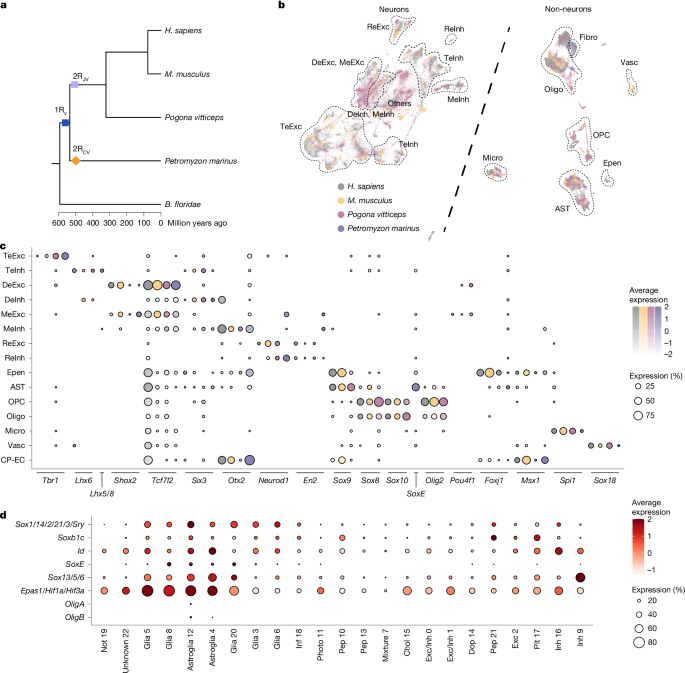
Researchers have demonstrated that whole-genome duplications (WGDs) in early vertebrate evolution played a key role in shaping the diversity of cell types found in modern vertebrate brains. The study analyzed brain cell atlases across multiple vertebrate species to trace how duplicated genes were retained and co-opted into new gene regulatory networks. This finding helps explain how vertebrates developed the complex brain cell diversity that underlies their sophisticated neural capabilities.
A new study published in Nature News reveals that whole-genome duplications occurring early in vertebrate evolution were instrumental in generating the diversity of brain cell types seen today. Researchers examined conserved transcription factor programs across brain cell atlases from multiple vertebrate species, identifying how duplicated genes were retained and diverged following ancient polyploidy events. The work builds on the '2R hypothesis,' which proposes two whole-genome duplications occurred in early jawed vertebrate evolution, with additional independent duplications in cyclostome lineages. Rather than being lost after duplication, many genes were co-opted into evolving gene regulatory networks that drove the specification of new cell types during development. The study emphasizes the hierarchical nature of cell-type evolution and demonstrates that investigating this process across different body regions and evolutionary levels is essential to understanding vertebrate complexity.
Limitations & open questions
The article excerpt does not provide specific details about which vertebrate species were compared in the brain atlases, the number of cell types identified, or the specific mechanisms by which duplicated genes were co-opted into new regulatory networks. Additionally, the functional consequences of cell-type diversification for vertebrate behavior and ecology are mentioned conceptually but not elaborated with concrete examples.
What different sources said
- Nature NewsCenter
Whole-genome duplication shaped cell-type evolution in the vertebrate brain
Related
Study reveals IDH1 enzyme's role in cardiac metabolic adaptation during cancer-related stress
Researchers discovered that isocitrate dehydrogenase 1 (IDH1) helps the heart adapt to metabolic stress caused by cancer-related mutations through a previously unknown reductive metabolic pathway. The study used stable isotope tracing and genetic knockout models in rat and mouse heart tissue to show that when mitochondrial metabolism is impaired, IDH1 redirects carbon flux toward glutamine-derived citrate formation. This finding expands understanding of how cardiac metabolism responds to oncometabolic stress and may have implications for managing cardiovascular complications in cancer patients.
AI Framework Reveals How β-Arrestin 1 Protein Changes Shape During Activation
Researchers used a transformer-based artificial intelligence model to analyze how the β-arrestin 1 protein's tail region reorganizes when activated by cell surface receptors. The study examined molecular dynamics simulations comparing the protein in resting and active states, uncovering previously unknown conformational changes. This work could improve understanding of how cells regulate signaling pathways involved in numerous physiological and disease processes.
Study Links Pancreatic Cancer Tissue Stiffness to Tumor Progression and Patient Survival
Researchers combined imaging scans and laboratory tissue analysis to show that pancreatic cancer tumors with greater stiffness—driven by dense collagen buildup—correlate with worse patient survival outcomes. The study of nine patients found that magnetic resonance elastography, a non-invasive imaging technique, can detect mechanical properties that reflect underlying tumor biology. These findings suggest that measuring tissue stiffness through imaging could help doctors better characterize pancreatic cancer and guide treatment decisions.