Two-Component Exciton Condensates Observed in Electron-Hole Bilayers
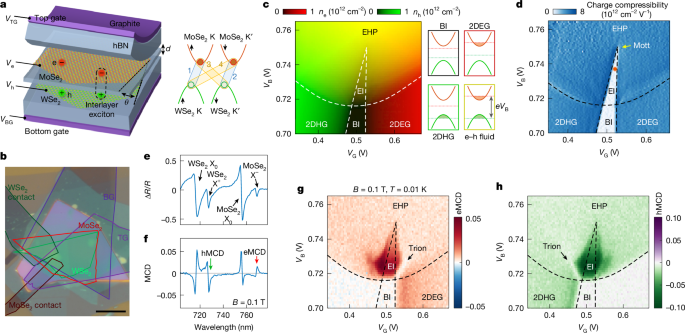
Researchers have demonstrated two-component exciton condensates in electron-hole bilayer systems, a quantum phenomenon where electron-hole pairs condense into a coherent state. This builds on recent breakthroughs in excitonic insulators and represents progress toward understanding exotic quantum phases in van der Waals heterostructures. The findings advance fundamental condensed matter physics and could have implications for quantum materials and device applications.
Scientists have successfully created and characterized two-component exciton condensates in electron-hole bilayer systems, extending theoretical predictions into experimental reality. The work leverages van der Waals heterostructures—layered materials with precisely controlled electron-hole interactions—to achieve the necessary conditions for exciton condensation. This research connects to a broader recent surge in excitonic insulator studies, with multiple groups publishing complementary findings on perfect Coulomb drag and exciton transport in similar systems. The study employs custom computational methods to model the interacting boson Hamiltonian governing these systems, with datasets and code made available for reproducibility. These results represent a significant step in realizing high-temperature superfluidity and exotic quantum phases predicted decades ago but only recently made experimentally accessible.
Limitations & open questions
The provided text appears to be primarily reference material and data availability statements rather than a complete article narrative. Key details about the experimental methods, specific findings, magnitude of the effect, and practical implications are not included in the source material provided.
What different sources said
- Nature NewsCenter
Two-component exciton condensates in an electron–hole bilayer
Related
Study reveals IDH1 enzyme's role in cardiac metabolic adaptation during cancer-related stress
Researchers discovered that isocitrate dehydrogenase 1 (IDH1) helps the heart adapt to metabolic stress caused by cancer-related mutations through a previously unknown reductive metabolic pathway. The study used stable isotope tracing and genetic knockout models in rat and mouse heart tissue to show that when mitochondrial metabolism is impaired, IDH1 redirects carbon flux toward glutamine-derived citrate formation. This finding expands understanding of how cardiac metabolism responds to oncometabolic stress and may have implications for managing cardiovascular complications in cancer patients.
AI Framework Reveals How β-Arrestin 1 Protein Changes Shape During Activation
Researchers used a transformer-based artificial intelligence model to analyze how the β-arrestin 1 protein's tail region reorganizes when activated by cell surface receptors. The study examined molecular dynamics simulations comparing the protein in resting and active states, uncovering previously unknown conformational changes. This work could improve understanding of how cells regulate signaling pathways involved in numerous physiological and disease processes.
Study Links Pancreatic Cancer Tissue Stiffness to Tumor Progression and Patient Survival
Researchers combined imaging scans and laboratory tissue analysis to show that pancreatic cancer tumors with greater stiffness—driven by dense collagen buildup—correlate with worse patient survival outcomes. The study of nine patients found that magnetic resonance elastography, a non-invasive imaging technique, can detect mechanical properties that reflect underlying tumor biology. These findings suggest that measuring tissue stiffness through imaging could help doctors better characterize pancreatic cancer and guide treatment decisions.