Study reveals mechanical basis of decision-making in slime molds
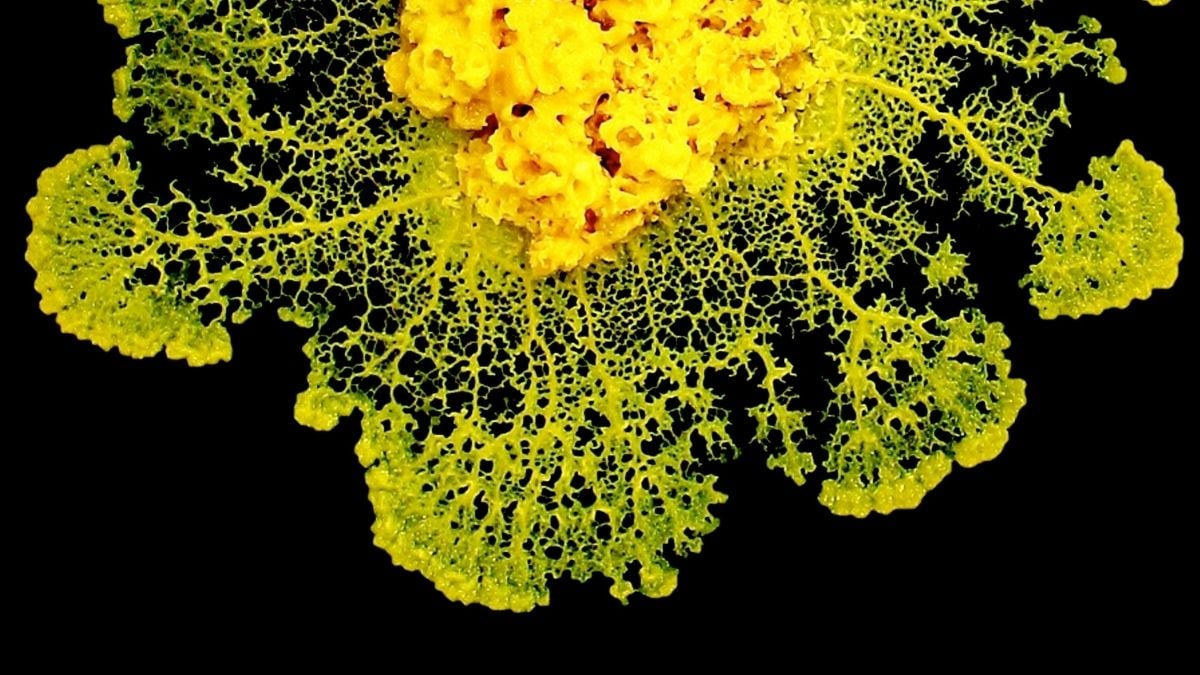
Researchers have found that the brainless slime mold Physarum polycephalum makes escape decisions through a gradual mechanical reorganization of internal peristaltic contraction waves rather than any centralized control. Confined by blue-light barriers into geometric shapes, the organism probes all directions before eventually aligning its dominant contraction mode along the shape's longest axis, where pressure builds most efficiently to drive a mass escape. The findings illuminate how decentralized biological systems can produce adaptive, apparently 'intelligent' behavior through purely physical fluid-dynamics principles.
A study published in PRX Life by researchers at the Technical University of Munich and collaborators in the United States reveals the mechanical basis of decision-making in Physarum polycephalum, a single-celled slime mold with no brain or nervous system. Using barriers of 470 nm blue light shaped into polygons — triangles, squares, hexagons, and other forms — the team trapped starved slime molds and observed their escape behavior over periods of roughly 6 to 18 hours. Time-lapse imaging showed the organism extending small protrusions in nearly all directions during an exploratory phase, while phase-of-contraction maps revealed traveling peristaltic waves continuously shifting orientation across the organism's body. Rather than immediately selecting the optimal escape route, the mold cycled through multiple dominant contraction modes before gradually settling on the one aligned with the shape's longest axis — the configuration that allows the greatest pressure buildup and mass transport. Crucially, the escape always occurred along this longest axis regardless of the polygon's specific geometry, suggesting the trap shape itself passively selects the mechanically optimal mode. The researchers conclude that harsh environmental confinement, rather than any internal computation, triggers this optimization by forcing prolonged reorganization of internal flow patterns. The work offers a concrete mechanical framework for understanding how non-neuronal organisms process environmental constraints to generate adaptive behavior.
What's missing
The study does not address whether the time required for contraction-mode reorganization scales with organism size or starvation duration, nor whether the same longest-axis escape rule holds in three-dimensional or non-planar confinement geometries. It also remains open whether other slime mold species or other non-neuronal organisms exhibit analogous mechanical decision-making mechanisms.
What different sources said
- ScienceAlertCenter
Physicists Discover How Slime Mold 'Makes Decisions' Without a Brain
- arXiv physicsCenter
Decision-making in light-trapped slime molds involves active mechanical processes
Related
Gut Bacteria Enzyme Found to Break Down Heat-Processed Food Compounds, Producing Novel Biogenic Amines
Researchers have discovered that an enzyme in common gut bacteria can degrade N-epsilon-carboxymethyllysine (CML), a compound formed during thermal food processing, producing previously unknown biogenic amines. The enzyme, ornithine decarboxylase SpeC from enterobacteria, acts on CML and related modified lysine derivatives through a low-level 'underground' catalytic activity. This finding suggests a previously unrecognized communication axis between thermally processed dietary compounds and gut microbial physiology, with potential implications for host health.
Full-Length Gene Sequencing Reveals Two Distinct Bacterial Communities in Black-Legged Ticks Expanding Into Canada
Researchers used Oxford Nanopore full-length 16S rRNA gene sequencing to characterize the microbiome of Ixodes scapularis black-legged ticks collected in Nova Scotia, Canada, distinguishing between tick-adapted bacteria and environmentally acquired bacteria. The study comes as I. scapularis — the primary vector of Lyme disease — is rapidly expanding northward into Canada due to climate change. The findings suggest that environmentally derived bacteria in tick microbiomes are not mere contamination, which has implications for how tick microbiome data is collected and interpreted across surveillance studies.
Study Identifies Metabolic Link Between Cell Envelope Stress and Biofilm Formation in Bacteria
Researchers have discovered that the metabolite acetyl-CoA directly inhibits enzymes that degrade the bacterial signaling molecule c-di-GMP, connecting cell envelope biosynthesis stress to biofilm formation in Pseudomonas aeruginosa. The study found that sub-inhibitory concentrations of antibiotics targeting early peptidoglycan biosynthesis — but not other antibiotic classes — elevate c-di-GMP levels by reducing phosphodiesterase activity, with acetyl-CoA competing for the enzyme active site. Because the relevant enzyme domain is broadly conserved across bacterial species, this checkpoint mechanism may be widespread and could have implications for understanding antibiotic-induced biofilm responses.