Study Reveals How Specific Mutations Influence Blood Cell Response to Sleep and Exercise
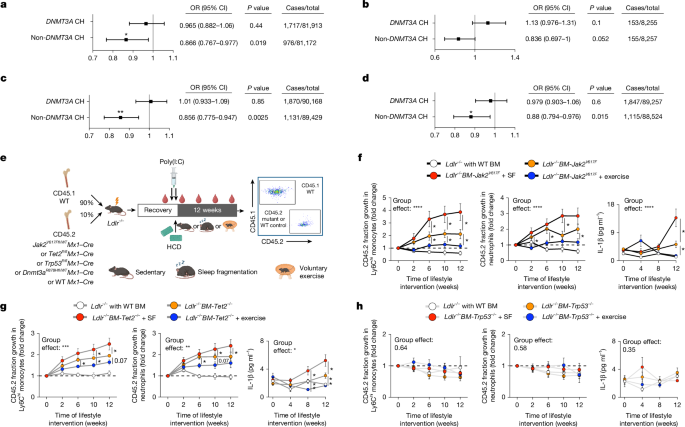
A study published in Nature found that the effects of sleep fragmentation and exercise on clonal hematopoiesis (CH) — the age-related expansion of blood stem cell clones carrying somatic mutations — depend critically on which mutation drives the clonal expansion. Researchers used mouse models carrying four common CH mutations (JAK2 V617F, TET2, p53, and DNMT3A) alongside large human biobank analyses to map these mutation-specific responses. The findings suggest that lifestyle interventions for CH-related cardiovascular risk may need to be tailored to a patient's specific mutation profile rather than applied uniformly.
Researchers at the Icahn School of Medicine at Mount Sinai and collaborating institutions investigated how sleep fragmentation (SF) and voluntary exercise influence clonal hematopoiesis across four distinct driver mutations: JAK2 V617F, TET2 loss-of-function, p53 loss-of-function, and DNMT3A R878H. Using bone marrow transplant mouse models on an atherosclerosis-prone Ldlr−/− background, the team tracked clonal expansion, inflammatory cell production, and atherosclerotic plaque development under sedentary, sleep-fragmented, and exercise conditions. Single-cell RNA sequencing of bone marrow and aortic leukocytes revealed mutation-specific transcriptional programs, with JAK2 V617F clones showing heightened IL-1β signaling and CLEC4E-mediated inflammasome activation under sleep fragmentation, while exercise suppressed JAK2 V617F clone expansion partly through beta-2 adrenergic receptor (ADRβ2) signaling. Human data from the UK Biobank and the All of Us Research Program corroborated mutation-dependent associations between physical activity levels and CH prevalence. The study identifies distinct mechanistic pathways — including IL-1β, neutrophil extracellular traps, and adrenergic signaling — as potential therapeutic targets that differ by mutation context, underscoring the need for precision approaches to lifestyle-based cardiovascular risk reduction in CH carriers.
What's missing
The study relies on bone marrow transplant mouse models, which may not fully recapitulate the mosaic, low-variant-allele-fraction clonal dynamics typical of human CH. The study does not report long-term clinical endpoints (e.g., myocardial infarction, stroke) in humans stratified by mutation type and lifestyle, leaving the translational magnitude of the mutation-specific effects uncertain.
What different sources said
- Nature NewsCenter
Mutation-dependent responses to sleep and exercise in clonal haematopoiesis
Related

Chicago Woman's Five-Year Symptom Journey Leads to Rare Brain Tumor Diagnosis
Melony Aponte, 26, was diagnosed with a 4.5-centimeter acoustic neuroma after five years of symptoms she attributed to stress, COVID-19, and aging. The rare, noncancerous tumor—affecting roughly one in 100,000 people—had grown large enough to compress her hearing and balance nerve before it was identified via MRI in March 2025. Her case highlights how acoustic neuroma symptoms can mimic common conditions, potentially delaying diagnosis for years.

Study Finds Aging Shifts Walking Strategy Toward Stability at the Cost of Efficiency
A new study from Flinders University and the University of Canberra found that as people age, their bodies adopt a 'safety-first' walking pattern that prioritizes balance over efficient movement. Researchers analyzed gait data from 107 healthy adults aged 26 to 86, identifying increased ankle muscle co-contraction and reduced push-off power as key age-related changes. The findings suggest that fall prevention programs should target balance and coordination, not just muscle strength.

Tick Populations Surge in Urban Areas Across Northeast
Experts across the northeastern United States and Canada are warning of an unusually early and widespread tick season, with disease-carrying ticks increasingly found in urban parks and green spaces. Lyme disease cases in Canada reached a record 7,105 in 2025, up from 5,809 the previous year, while U.S. cities including Philadelphia, Pittsburgh, Washington D.C., and New York are reporting rising tick activity. The expansion poses a public health challenge because urban residents are less likely to take tick-bite precautions than those in rural areas.