Scientists Develop High-Yield Process to Convert Lignin into Adipic Acid Using Chemical and Biological Methods
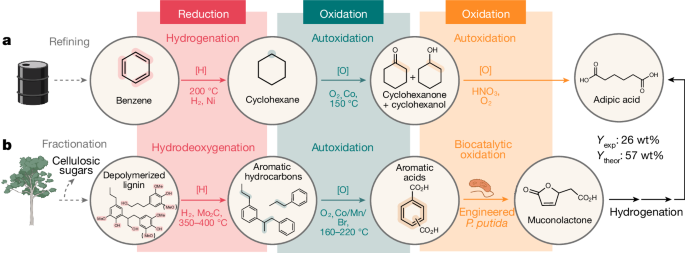
Researchers have demonstrated a combined chemical and biological process that converts lignin, a waste product from wood processing, into adipic acid with high efficiency. Adipic acid is a widely used industrial chemical currently produced from petroleum, making this a potential sustainable alternative. The breakthrough could reduce the carbon footprint of chemical manufacturing and create economic value from biomass waste.
A research team has published findings in Nature describing a hybrid approach that uses both chemical catalysis and biological engineering to convert lignin into adipic acid at high yields. Lignin, an abundant but underutilized component of plant biomass, has long been targeted as a renewable feedstock for chemical production. The process combines oxidative cleavage of carbon-carbon bonds in lignin with metabolic engineering of microorganisms to complete the conversion. Adipic acid is a key industrial chemical used in plastics, textiles, and other products, currently produced almost entirely from petroleum-derived cyclohexane. This development represents progress toward sustainable biorefinery processes that could reduce dependence on fossil fuels and lower greenhouse gas emissions in chemical manufacturing. The research includes detailed data availability and references to related work on lignin valorization and sustainable aviation fuels.
Limitations & open questions
The source material provided appears to be primarily references and data availability statements rather than a complete article narrative. Key details about the specific yields achieved, reaction conditions, scalability prospects, timeline to commercialization, and the research team's institution are not present in the excerpt provided. Additionally, the study's own limitations, challenges in scaling the process, or remaining technical hurdles are not discussed in the available text.
What different sources said
- Nature NewsCenter
Lignin to adipic acid in a high-yield chemical and biological redox process
Related
Study reveals IDH1 enzyme's role in cardiac metabolic adaptation during cancer-related stress
Researchers discovered that isocitrate dehydrogenase 1 (IDH1) helps the heart adapt to metabolic stress caused by cancer-related mutations through a previously unknown reductive metabolic pathway. The study used stable isotope tracing and genetic knockout models in rat and mouse heart tissue to show that when mitochondrial metabolism is impaired, IDH1 redirects carbon flux toward glutamine-derived citrate formation. This finding expands understanding of how cardiac metabolism responds to oncometabolic stress and may have implications for managing cardiovascular complications in cancer patients.
AI Framework Reveals How β-Arrestin 1 Protein Changes Shape During Activation
Researchers used a transformer-based artificial intelligence model to analyze how the β-arrestin 1 protein's tail region reorganizes when activated by cell surface receptors. The study examined molecular dynamics simulations comparing the protein in resting and active states, uncovering previously unknown conformational changes. This work could improve understanding of how cells regulate signaling pathways involved in numerous physiological and disease processes.
Study Links Pancreatic Cancer Tissue Stiffness to Tumor Progression and Patient Survival
Researchers combined imaging scans and laboratory tissue analysis to show that pancreatic cancer tumors with greater stiffness—driven by dense collagen buildup—correlate with worse patient survival outcomes. The study of nine patients found that magnetic resonance elastography, a non-invasive imaging technique, can detect mechanical properties that reflect underlying tumor biology. These findings suggest that measuring tissue stiffness through imaging could help doctors better characterize pancreatic cancer and guide treatment decisions.