Scientists Complete First Full Map of Fruit Fly Brain and Nerve Cord Connections
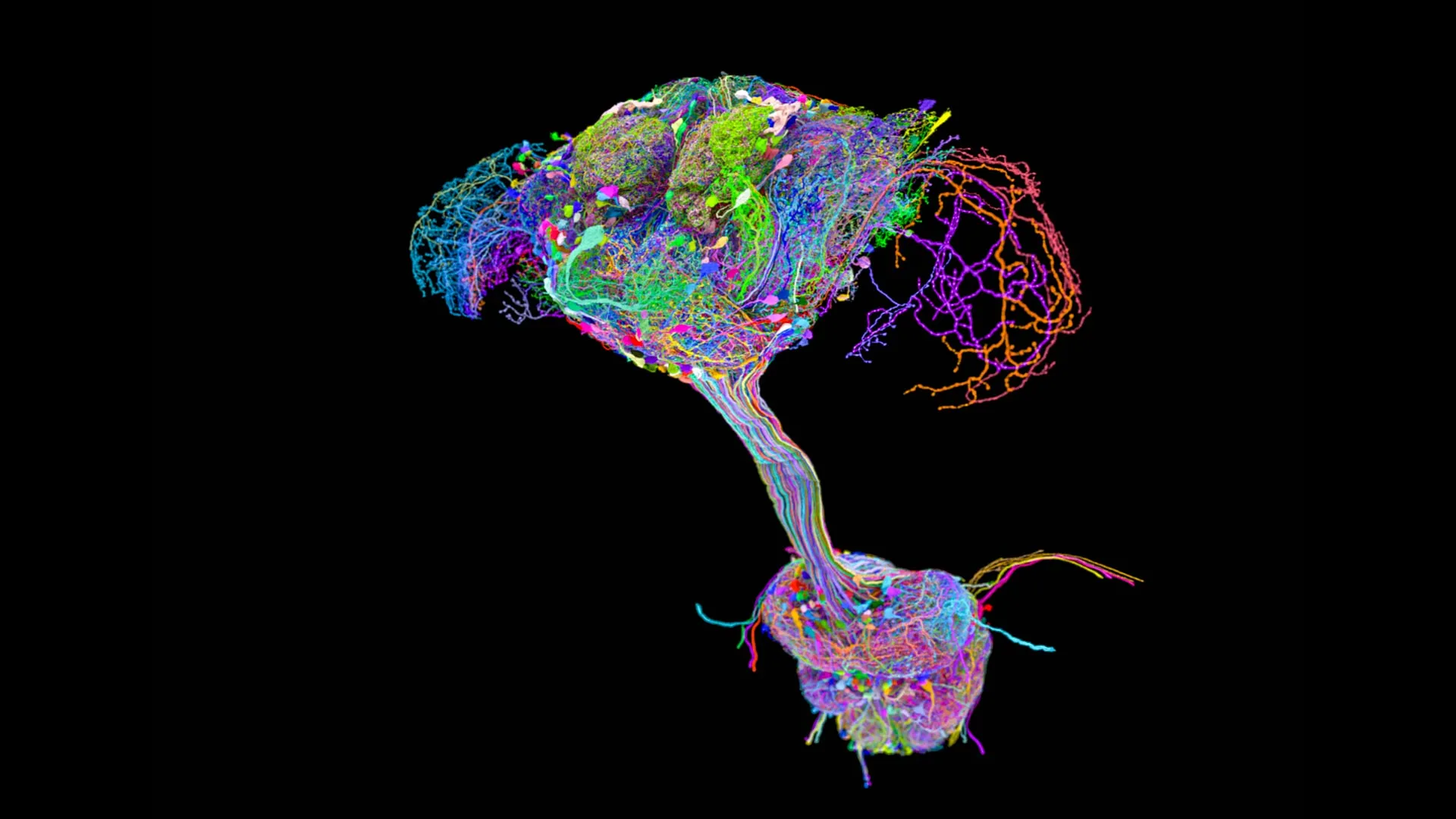
Researchers led by Harvard Medical School and Princeton University have published a complete connectome—a map of all neural connections—in a fruit fly's central nervous system, including both the brain and nerve cord. This builds on a 2024 brain-only connectome by adding the nerve cord, which controls movement and processes sensory information. The discovery reveals that many behaviors are directed by local neural circuits in body parts rather than centralized brain commands, offering insights into how nervous systems generate complex behavior.
An international research team has achieved a major neuroscience milestone by mapping every neural connection in an adult fruit fly's central nervous system, combining the brain and nerve cord into a single connectome. The work, published in Nature on June 8, extends a previously published fruit fly brain connectome by integrating the nerve cord—the fly's spinal cord equivalent—which controls legs, wings, and other appendages while processing sensory information. The complete map reveals that many fruit fly behaviors appear to be directed by local neural circuits in relevant body parts rather than by centralized command from the brain, challenging previous assumptions about nervous system organization. The fruit fly Drosophila melanogaster serves as a valuable model organism because despite having only about 160,000 neurons, it performs complex behaviors including navigation, social interaction, learning, and sensory responses. The connectome is now freely available online to researchers worldwide, supported by U.S. federal funding including the BRAIN Initiative, National Institutes of Health, and National Science Foundation.
Limitations & open questions
The study's own limitations and open questions are not discussed in the provided excerpt. Additionally, the specific methodologies used to map the connections (electron microscopy techniques, image segmentation approaches, validation methods) are not detailed.
What different sources said
- Science DailyCenter
Scientists mapped every neural connection in a fruit fly and found a surprise
Related
Profilin-1 Deficiency Activates Immune Response Against Breast Cancer in Preclinical Study
Researchers found that removing the Profilin-1 protein from breast cancer cells triggers DNA damage and activates an immune pathway called STING, which recruits cancer-fighting T cells and causes tumor regression in mice. The study used CRISPR gene-editing technology to deplete Profilin-1 and observed that the resulting genomic instability paradoxically strengthens anti-tumor immunity. The findings suggest targeting Profilin-1 could be a new strategy to enhance immunotherapy effectiveness in breast cancer.
Computational Study Explores How Magnetic Fields May Affect Tomato Plant Ion Channels
Researchers used molecular dynamics simulations to investigate how static magnetic fields affect the CNGC6 ion channel in tomato plants, finding that magnetic fields may alter the channel's structure in specific ways. The study was motivated by observations that magnetic treatment of tomato seeds appears to speed germination and improve plant development, though the underlying cellular mechanisms remain unclear. The findings provide a computational foundation for future experimental work, though the authors emphasize this is a preliminary exploratory study requiring validation.
New Algorithm Simplifies Evolutionary Network Reconstruction for Hybridized Species
Researchers developed NetCS, a fast algorithm for reconstructing evolutionary networks in hybridized species that avoids expensive computational bottlenecks. The method works well when given accurate intermediate data but reveals that the real challenge in network inference lies in an earlier reconstruction step. This finding could enable phylogenetic analyses of larger datasets while identifying where future improvements are needed.