Researchers Use Deep Learning to Map Four Decades of Global Human Migration Flows
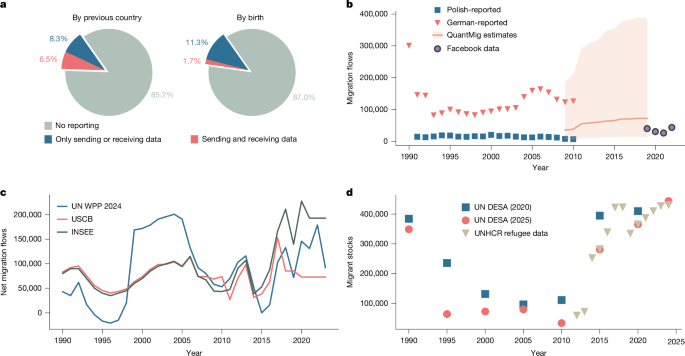
Scientists have developed a deep learning method to estimate annual human migration flows across countries from 1980 to 2020, addressing a major gap in global migration data. Current migration data relies on UN and World Bank snapshots taken at five- or ten-year intervals, which miss temporal dynamics and are heavily biased toward high-income Western countries. This new approach enables researchers to integrate migration patterns with other annually reported datasets on economic, conflict, climate, and policy factors for more precise analysis.
Researchers have created a deep learning framework to generate annual migration flow estimates spanning four decades of global human movement, filling a critical data gap in migration research. Existing global migration data comes primarily from UN and World Bank stock data collected at five- or ten-year intervals, providing only snapshots that obscure the timing and dynamics of migration movements. The new method addresses this limitation by estimating annual flows, which allows researchers to track migration systems with greater precision, correlate migration patterns with other annually reported drivers such as economic conditions, armed conflict, climate events, and policy changes, and feed data into annual population projection models. Current annual migration flow data are predominantly available only from high-income Western countries with robust statistical infrastructure, covering only a small fraction of global migration corridors and reinforcing a receiving-country bias in migration research. The deep learning approach enables both causal and comparative analyses across countries and regions that were previously difficult to conduct with existing data limitations.
What different sources said
- Nature NewsCenter
Deep learning four decades of human migration
Related
Study reveals IDH1 enzyme's role in cardiac metabolic adaptation during cancer-related stress
Researchers discovered that isocitrate dehydrogenase 1 (IDH1) helps the heart adapt to metabolic stress caused by cancer-related mutations through a previously unknown reductive metabolic pathway. The study used stable isotope tracing and genetic knockout models in rat and mouse heart tissue to show that when mitochondrial metabolism is impaired, IDH1 redirects carbon flux toward glutamine-derived citrate formation. This finding expands understanding of how cardiac metabolism responds to oncometabolic stress and may have implications for managing cardiovascular complications in cancer patients.
AI Framework Reveals How β-Arrestin 1 Protein Changes Shape During Activation
Researchers used a transformer-based artificial intelligence model to analyze how the β-arrestin 1 protein's tail region reorganizes when activated by cell surface receptors. The study examined molecular dynamics simulations comparing the protein in resting and active states, uncovering previously unknown conformational changes. This work could improve understanding of how cells regulate signaling pathways involved in numerous physiological and disease processes.
Study Links Pancreatic Cancer Tissue Stiffness to Tumor Progression and Patient Survival
Researchers combined imaging scans and laboratory tissue analysis to show that pancreatic cancer tumors with greater stiffness—driven by dense collagen buildup—correlate with worse patient survival outcomes. The study of nine patients found that magnetic resonance elastography, a non-invasive imaging technique, can detect mechanical properties that reflect underlying tumor biology. These findings suggest that measuring tissue stiffness through imaging could help doctors better characterize pancreatic cancer and guide treatment decisions.