Researchers Map Diverse Binding Poses of Neurotoxins on Human Sodium Channel Nav1.6
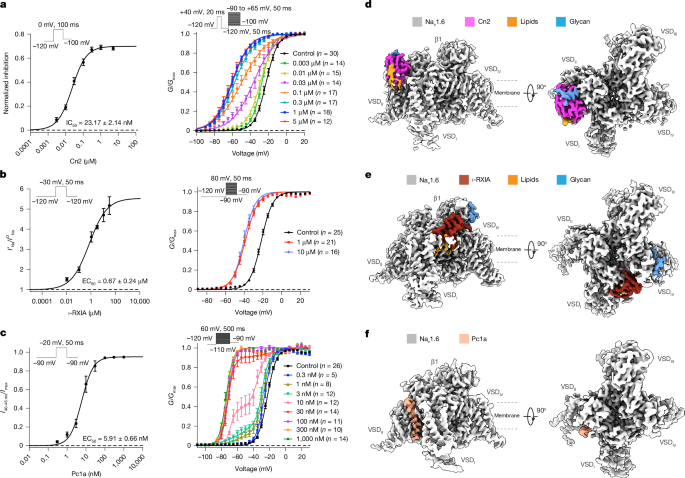
Scientists used cryo-electron microscopy to determine how three different agonistic neurotoxins bind to the human sodium channel Nav1.6 at distinct molecular sites. The study reveals multiple binding poses for toxins derived from cone snails and spiders, advancing understanding of how these toxins interact with ion channels. This research has implications for understanding ion channel function and developing therapeutics targeting sodium channels in neurological disorders.
A Nature study employed cryo-EM structural biology to characterize how agonistic neurotoxins bind to human Nav1.6, a voltage-gated sodium channel critical for neuronal signaling. The researchers determined three-dimensional structures of Nav1.6 complexed with toxins Cn2, ι-RXIA, and Pc1a, revealing that these neurotoxins adopt diverse binding poses on the channel. The cryo-EM maps and atomic coordinates have been deposited in public databases (EMDB and PDB), enabling further research. Nav1.6 is particularly important because it localizes to nodes of Ranvier and synapses, where it plays distinct roles in action potential initiation and propagation. Mutations in the SCN8A gene encoding Nav1.6 are associated with epilepsy and intellectual disability, making this channel a relevant target for therapeutic development. The structural insights from this work contribute to the broader effort of using animal-derived toxins as tools to understand ion channel mechanisms and as potential leads for drug discovery.
What different sources said
- Nature NewsCenter
Diverse binding poses of agonistic neurotoxins on human Na<sub>v</sub>1.6
Related
Study reveals IDH1 enzyme's role in cardiac metabolic adaptation during cancer-related stress
Researchers discovered that isocitrate dehydrogenase 1 (IDH1) helps the heart adapt to metabolic stress caused by cancer-related mutations through a previously unknown reductive metabolic pathway. The study used stable isotope tracing and genetic knockout models in rat and mouse heart tissue to show that when mitochondrial metabolism is impaired, IDH1 redirects carbon flux toward glutamine-derived citrate formation. This finding expands understanding of how cardiac metabolism responds to oncometabolic stress and may have implications for managing cardiovascular complications in cancer patients.
AI Framework Reveals How β-Arrestin 1 Protein Changes Shape During Activation
Researchers used a transformer-based artificial intelligence model to analyze how the β-arrestin 1 protein's tail region reorganizes when activated by cell surface receptors. The study examined molecular dynamics simulations comparing the protein in resting and active states, uncovering previously unknown conformational changes. This work could improve understanding of how cells regulate signaling pathways involved in numerous physiological and disease processes.
Study Links Pancreatic Cancer Tissue Stiffness to Tumor Progression and Patient Survival
Researchers combined imaging scans and laboratory tissue analysis to show that pancreatic cancer tumors with greater stiffness—driven by dense collagen buildup—correlate with worse patient survival outcomes. The study of nine patients found that magnetic resonance elastography, a non-invasive imaging technique, can detect mechanical properties that reflect underlying tumor biology. These findings suggest that measuring tissue stiffness through imaging could help doctors better characterize pancreatic cancer and guide treatment decisions.