Republicans gain redistricting advantage with 10 additional favorable House seats for 2026 midterms

An internal House Republican assessment obtained by the BBC, corroborated by nonpartisan analysts and multiple outlets, finds that mid-decade redistricting has given Republicans a net advantage of roughly 10 safer seats heading into the 2026 midterms. Republicans now hold 211 safe or leaning seats versus 205 for Democrats, with 19 toss-up races, according to chart data from the NYT analysis. The shift matters because it widens Republicans' margin for error in a political environment historically favorable to the opposition party.
The mid-decade redistricting battle that unfolded across multiple states has concluded with Republicans holding a structural edge of approximately 10 seats over Democrats for the 2026 House midterms, according to an internal National Republican Congressional Committee assessment obtained by the BBC and analyses from nonpartisan organizations including the Cook Political Report. Republicans drew 16 new favorable districts while Democrats drew only 6, leaving Democrats defending 23 House seats that Trump won in 2024—up from 13 at the start of the cycle—while Republicans hold just 8 seats won by Kamala Harris, up from 3. A chart from the NYT analysis shows Republicans with 181 safe seats and 24 leaning seats versus Democrats' 177 safe and 14 leaning seats, with 19 toss-ups, and illustrates that Republicans achieve this advantage despite receiving fewer raw votes than Democrats nationally. Key Republican gains came from Texas, Florida, Ohio, and several Southern states, partially offset by Democratic gains in California and a court-ordered Utah redraw, while Virginia's Democrat-drawn map was struck down by the state Supreme Court. Despite the structural advantage, Democrats and many strategists argue that Trump's near-record-low approval ratings, economic anxiety, and historical midterm trends—the president's party has gained House seats in only three midterms since 1934—still favor a Democratic takeover. Looking beyond 2026, analysts at The Downballot project Democrats could draw up to 21 new favorable districts across nine states by 2028, as many Democratic-controlled states were unable to act in time for this cycle.
Data: 270towin.com
What's missing
The sources do not detail the specific legal status of remaining redistricting litigation that could alter maps before November, nor do they quantify how candidate quality, fundraising disparities, or local economic conditions in individual toss-up districts might interact with the structural map advantage to affect the final seat count.
How coverage differed
The New York Post frames redistricting as giving Republicans an 'unexpected advantage' and focuses on the competitive mechanics of holding the majority, while Mother Jones emphasizes Republican 'election rigging' enabled by GOP-appointed judges and frames Democratic counter-gerrymandering as a necessary response to 'level the playing field.' The BBC and NYT present the structural shift more neutrally, noting both parties engaged in the redistricting fight.
What different sources said
- New York PostRight
Redistricting has given GOP unexpected midterm advantage. But can they win?
- Mother JonesLeft
How Democrats Can Still Win the Redistricting War by 2028
- BBC US & CanadaCenter
Republicans gained edge over Democrats in redistricting battle, internal party assessment finds
- NYT USLeft
Can Democrats Overcome G.O.P. Gerrymandering?
Related

Workers Begin Removing Trump's Name from Kennedy Center Facade After Court-Ordered Deadline
Workers started stripping President Trump's name from the exterior of the Kennedy Center in Washington overnight Friday into Saturday, hours past a court-ordered deadline of 11:59 p.m. Friday. The delay was attributed to nearby thunderstorms, and the Kennedy Center's board sought a 12-hour extension, which U.S. District Judge Christopher Cooper had already denied after rejecting the board's last-minute attempt to halt the order. The removal marks a significant legal rebuke of the Trump administration's effort to rename the historic performing arts venue, with a court ruling that only Congress has the authority to change the Kennedy Center's name.
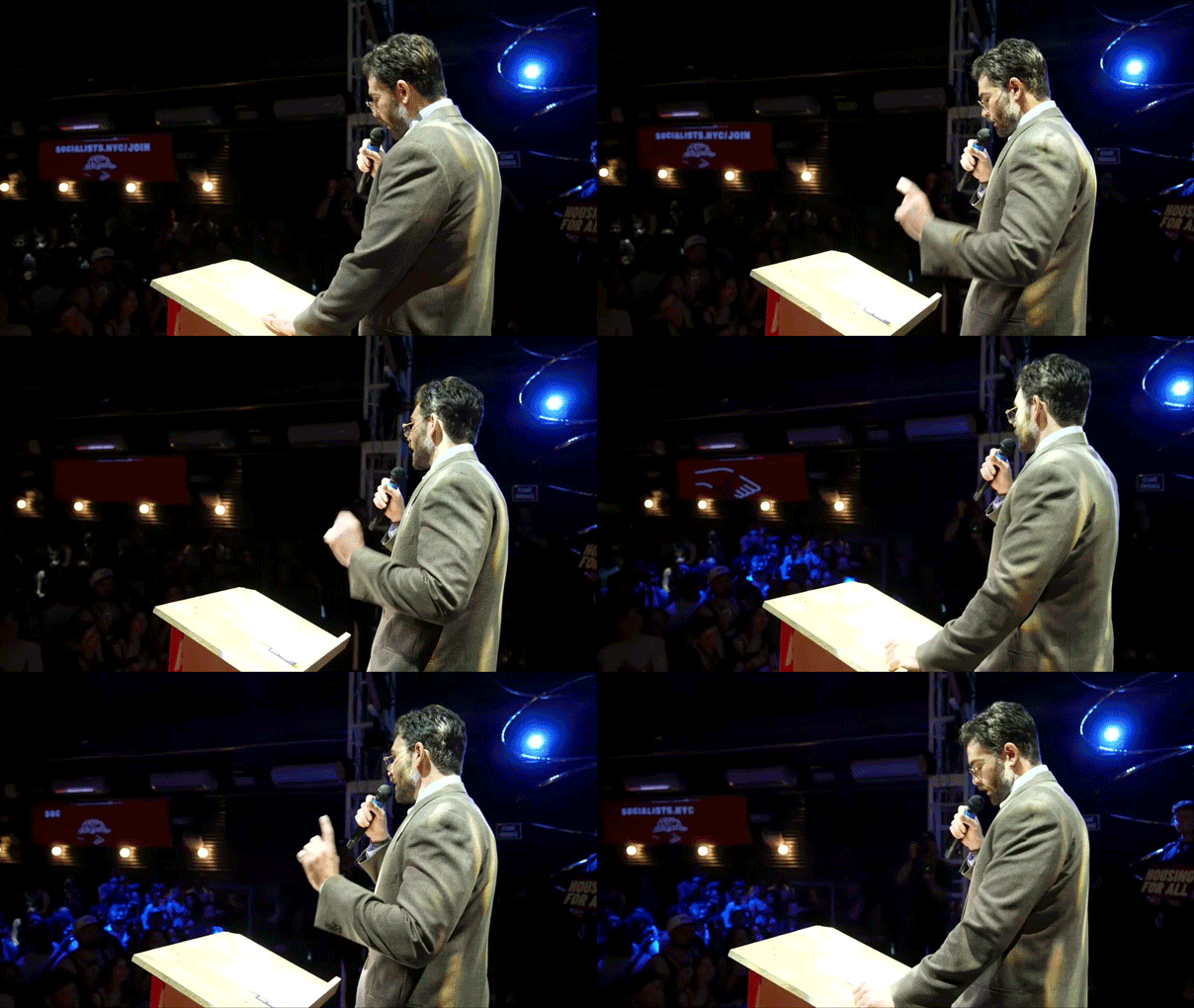
Hasan Piker Campaigns for DSA-Backed NYC Candidates, Sparking Debate Over Democratic Party Direction
Twitch streamer Hasan Piker rallied in Brooklyn for two Democratic Socialist of America-endorsed congressional candidates ahead of New York's June 23 primary, declaring the country is 'closer than ever' to socialism. The appearances come amid a broader debate within the Democratic Party over whether to embrace or distance itself from Piker, whose pro-Palestinian views and provocative statements have made him a polarizing figure. The controversy highlights a growing tension between the party's centrist establishment and its increasingly left-leaning base, particularly on foreign policy.

Fire Rescue Victoria Has Missed Emergency Response Targets Every Year Since 2020, With Outer Suburbs Worst Affected
Fire Rescue Victoria (FRV) has failed to meet its target of responding to 90 per cent of structural fires within seven minutes and 42 seconds in every year since its formation in 2020, with outer suburban areas recording the worst performance. The shortfall has come into sharp focus following the death of three-year-old Jordan Dashwood in a Werribee house fire this month, where the nearest FRV truck was committed to another incident and the first responders arrived well outside the benchmark time. The findings raise serious questions about whether the 2020 fire services restructure has been adequately resourced to protect Melbourne's rapidly growing outer suburbs.