Quantum Processors Achieve Improved Logical Error Rates Through Advanced Correction and Detection Methods
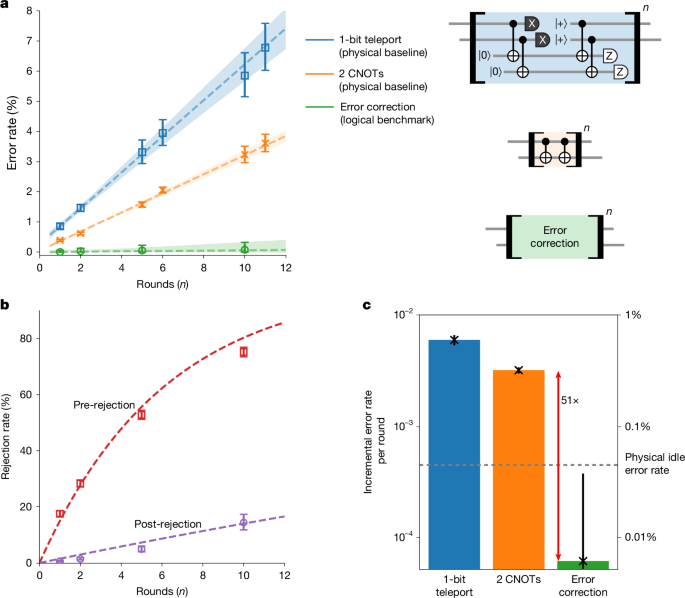
Researchers have demonstrated improved logical error rates in quantum processors using enhanced quantum error correction and detection techniques. This work builds on decades of theoretical foundations in fault-tolerant quantum computing and recent experimental breakthroughs in error suppression. The advancement is significant because reducing logical error rates is essential for scaling quantum computers toward practical applications.
A Nature publication reports progress in quantum processor performance through improved logical error rates via correction and detection mechanisms. The research draws on extensive theoretical work in fault-tolerant quantum computation dating back to the 1990s, as well as recent experimental demonstrations of quantum error correction beyond break-even and surface code implementations. The work references multiple contemporary approaches including trapped-ion processors, semiconductor quantum dots, and various quantum error correction codes. The achievement represents incremental but meaningful progress in addressing one of the fundamental challenges in quantum computing: managing the errors that accumulate as quantum systems scale. The researchers have made their experimental data and quantum circuits available upon request, supporting reproducibility and further investigation by the scientific community.
Limitations & open questions
The provided text consists primarily of references and data availability statements rather than a complete article narrative. Key missing details include: the specific magnitude of error rate improvements achieved, the particular quantum hardware platform(s) used, comparison metrics to prior work, and the practical implications for near-term quantum computing applications. Additionally, the study's own limitations regarding scalability, the number of qubits involved, and the conditions under which these improvements were demonstrated are not evident from the provided excerpt.
What different sources said
- Nature NewsCenter
Improved quantum processor logical error rates via correction and detection
Related
Study reveals IDH1 enzyme's role in cardiac metabolic adaptation during cancer-related stress
Researchers discovered that isocitrate dehydrogenase 1 (IDH1) helps the heart adapt to metabolic stress caused by cancer-related mutations through a previously unknown reductive metabolic pathway. The study used stable isotope tracing and genetic knockout models in rat and mouse heart tissue to show that when mitochondrial metabolism is impaired, IDH1 redirects carbon flux toward glutamine-derived citrate formation. This finding expands understanding of how cardiac metabolism responds to oncometabolic stress and may have implications for managing cardiovascular complications in cancer patients.
AI Framework Reveals How β-Arrestin 1 Protein Changes Shape During Activation
Researchers used a transformer-based artificial intelligence model to analyze how the β-arrestin 1 protein's tail region reorganizes when activated by cell surface receptors. The study examined molecular dynamics simulations comparing the protein in resting and active states, uncovering previously unknown conformational changes. This work could improve understanding of how cells regulate signaling pathways involved in numerous physiological and disease processes.
Study Links Pancreatic Cancer Tissue Stiffness to Tumor Progression and Patient Survival
Researchers combined imaging scans and laboratory tissue analysis to show that pancreatic cancer tumors with greater stiffness—driven by dense collagen buildup—correlate with worse patient survival outcomes. The study of nine patients found that magnetic resonance elastography, a non-invasive imaging technique, can detect mechanical properties that reflect underlying tumor biology. These findings suggest that measuring tissue stiffness through imaging could help doctors better characterize pancreatic cancer and guide treatment decisions.