Nvidia Unveils Cosmos 3, an Open AI World Model for Robots and Autonomous Vehicles
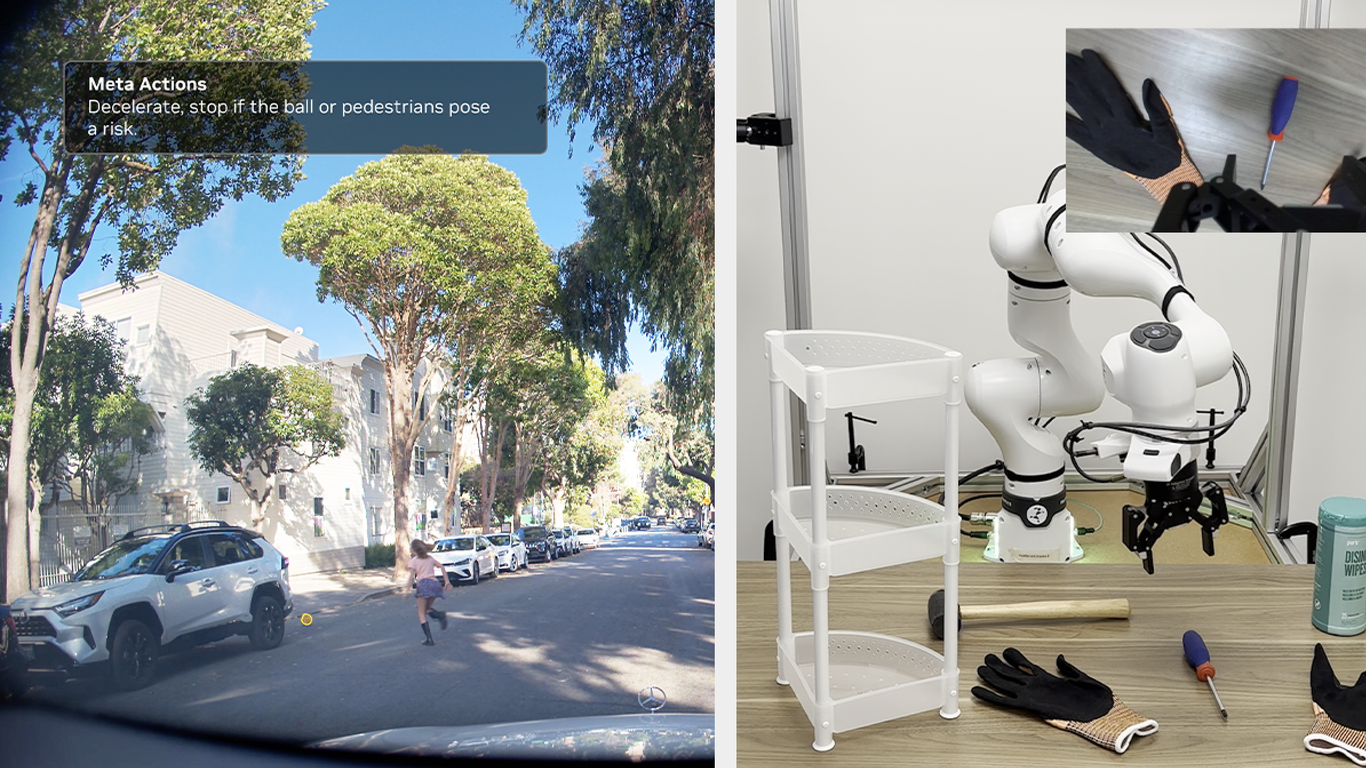
NVIDIA has unveiled Cosmos 3, a family of open-source AI world models capable of jointly processing and generating language, images, video, audio, and action sequences within a single unified architecture. Trained on 20 trillion tokens of multimodal data — including nearly a billion images, 400 million videos, and robot action data — the system is designed to help robots, autonomous vehicles, and other physical AI systems understand and simulate real-world environments. The release marks a significant expansion of NVIDIA's role beyond chip hardware into foundational AI software for embodied and physical agents.
NVIDIA's Cosmos 3 is a family of omnimodal world models built on a mixture-of-transformers architecture that unifies vision-language understanding, video generation, world simulation, and action modeling into a single framework. The system was trained on 20 trillion tokens of multimodal data, including approximately one billion images, 400 million real and synthetic videos, ambient audio, text, and action data from both humans and robots. A key differentiator from conventional video generators is its ability to produce action data — such as robot joint angles, gripper positions, and movement trajectories — enabling developers to simulate physical tasks and train task-specific models on top of it. NVIDIA is releasing two immediate variants: a 'super' model optimized for high physics accuracy in robotics and autonomous vehicle training, and a 'nano' model capable of generating results in fractions of a second, with an 'edge' model for local deployment coming soon. Post-trained versions of Cosmos 3 were ranked as the best open-source text-to-image and image-to-video models by Artificial Analysis, and the best policy model by RoboArena at the time of publication. The models, code, curated synthetic datasets, and evaluation benchmarks are being released under the Linux Foundation's OpenMDW-1.1 License, with initial industry partners including Agile Robots, Black Forest Labs, and Runway. NVIDIA frames the effort as positioning itself as a foundational platform for the next wave of AI — one that must predict, simulate, and act in the physical world rather than merely answer questions or generate content.
What's missing
The OpenMDW-1.1 License terms — including any restrictions on commercial use or fine-tuning — are not described in either source.
What different sources said
- AxiosCenter
Nvidia's new world model helps robots navigate the world
- arXiv cs.AICenter
Cosmos 3: Omnimodal World Models for Physical AI
Related
Gut Bacteria Enzyme Found to Break Down Heat-Processed Food Compounds, Producing Novel Biogenic Amines
Researchers have discovered that an enzyme in common gut bacteria can degrade N-epsilon-carboxymethyllysine (CML), a compound formed during thermal food processing, producing previously unknown biogenic amines. The enzyme, ornithine decarboxylase SpeC from enterobacteria, acts on CML and related modified lysine derivatives through a low-level 'underground' catalytic activity. This finding suggests a previously unrecognized communication axis between thermally processed dietary compounds and gut microbial physiology, with potential implications for host health.
Full-Length Gene Sequencing Reveals Two Distinct Bacterial Communities in Black-Legged Ticks Expanding Into Canada
Researchers used Oxford Nanopore full-length 16S rRNA gene sequencing to characterize the microbiome of Ixodes scapularis black-legged ticks collected in Nova Scotia, Canada, distinguishing between tick-adapted bacteria and environmentally acquired bacteria. The study comes as I. scapularis — the primary vector of Lyme disease — is rapidly expanding northward into Canada due to climate change. The findings suggest that environmentally derived bacteria in tick microbiomes are not mere contamination, which has implications for how tick microbiome data is collected and interpreted across surveillance studies.
Study Identifies Metabolic Link Between Cell Envelope Stress and Biofilm Formation in Bacteria
Researchers have discovered that the metabolite acetyl-CoA directly inhibits enzymes that degrade the bacterial signaling molecule c-di-GMP, connecting cell envelope biosynthesis stress to biofilm formation in Pseudomonas aeruginosa. The study found that sub-inhibitory concentrations of antibiotics targeting early peptidoglycan biosynthesis — but not other antibiotic classes — elevate c-di-GMP levels by reducing phosphodiesterase activity, with acetyl-CoA competing for the enzyme active site. Because the relevant enzyme domain is broadly conserved across bacterial species, this checkpoint mechanism may be widespread and could have implications for understanding antibiotic-induced biofilm responses.