NASA Names Four-Astronaut Crew for Artemis III Moon Mission Launching in 2027
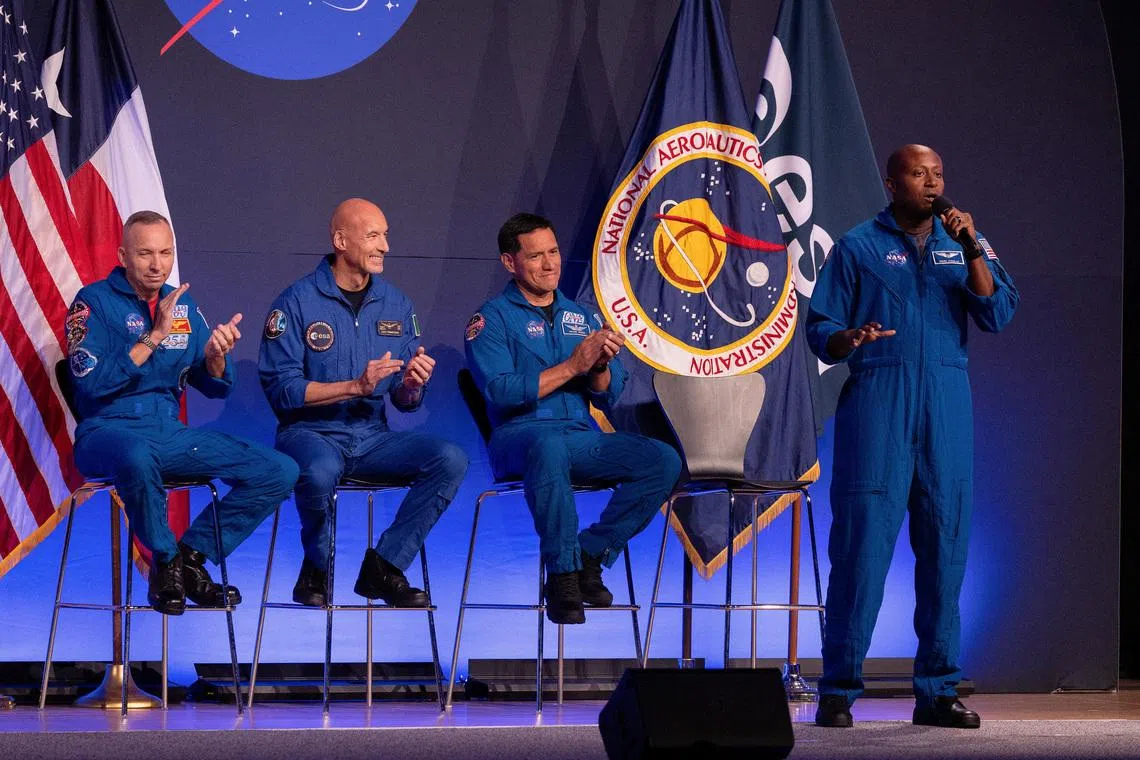
NASA announced on Tuesday that U.S. astronauts Randy Bresnik, Frank Rubio, and Andre Douglas, along with Italian astronaut Luca Parmitano of the European Space Agency, will crew the Artemis III mission scheduled for 2027. The mission will conduct a docking demonstration in Earth's orbit involving spacecraft from SpaceX and Blue Origin, marking the first in-space test of moon landers from both companies. The crew selection highlights international collaboration in NASA's lunar program and includes a record-holder for longest U.S. spaceflight and a first-time space flyer.
NASA has selected a four-person crew for Artemis III, its next major lunar exploration mission planned for 2027. The crew comprises mission commander Randy Bresnik, a 58-year-old test pilot and retired Marine Corps colonel with three previous spaceflights and 150 days in space; pilot Luca Parmitano, a 49-year-old Italian ESA astronaut making him the first European Space Agency astronaut on an Artemis mission; mission specialist Frank Rubio, a 50-year-old who holds the U.S. record for longest continuous spaceflight at 371 days; and mission specialist Andre Douglas, a 40-year-old first-time space flyer with advanced engineering credentials. The mission will conduct a docking demonstration involving three spacecraft in Earth's orbit, testing moon landers developed by SpaceX and Blue Origin for the first time in space. This selection underscores NASA's commitment to international partnership in its Artemis program, with Parmitano representing Italy's expanded role alongside other international partners.
What different sources said
- The Straits TimesCenter
NASA's Artemis III crew: a test pilot, an Italian, a record-holder and a first-timer
Related
Study Examines How 'Undone Science' Shaped Chile's Glacier Protection Conflicts
A new study published in Tapuya: Latin American Science, Technology and Society explores how gaps in scientific knowledge enabled mining projects to avoid scrutiny in Chile's glacier conservation debates. 'Undone science'—areas of knowledge that are absent or contested—allowed significant environmental impacts to escape regulatory attention over two decades. The research highlights how incomplete scientific understanding can shape environmental policy outcomes globally.
Mathematical Framework Unifies Three Theories of Brain Dynamics Through Single Operator Model
Researchers propose that three distinct mathematical frameworks for describing brain dynamics—connectome harmonics, turbulence, and complex harmonics—can be unified as different expressions of a single self-adjoint operator based on the connectome Laplacian. The study tests this prediction using LSD as a pharmacological perturbation, finding that harmonic energy redistribution and turbulence shifts respond in unison to structural changes in the operator. This unification could provide a fundamental mathematical foundation for understanding how brain structure constrains neural dynamics across multiple scales.
ACTRT2 Protein Loss Causes Male Subfertility and Acrosome Defects in Mice
Researchers found that loss of the ACTRT2 protein in mice causes male subfertility and malformed acrosomes (sperm head structures) during development. ACTRT2 is a conserved protein that localizes to the perinuclear theca and interacts with multiple other testis-specific proteins to regulate actin dynamics. The findings establish ACTRT2 as a key structural regulator of sperm head architecture and male fertility.