NASA Announces Four-Astronaut Crew for Artemis III Moon Mission
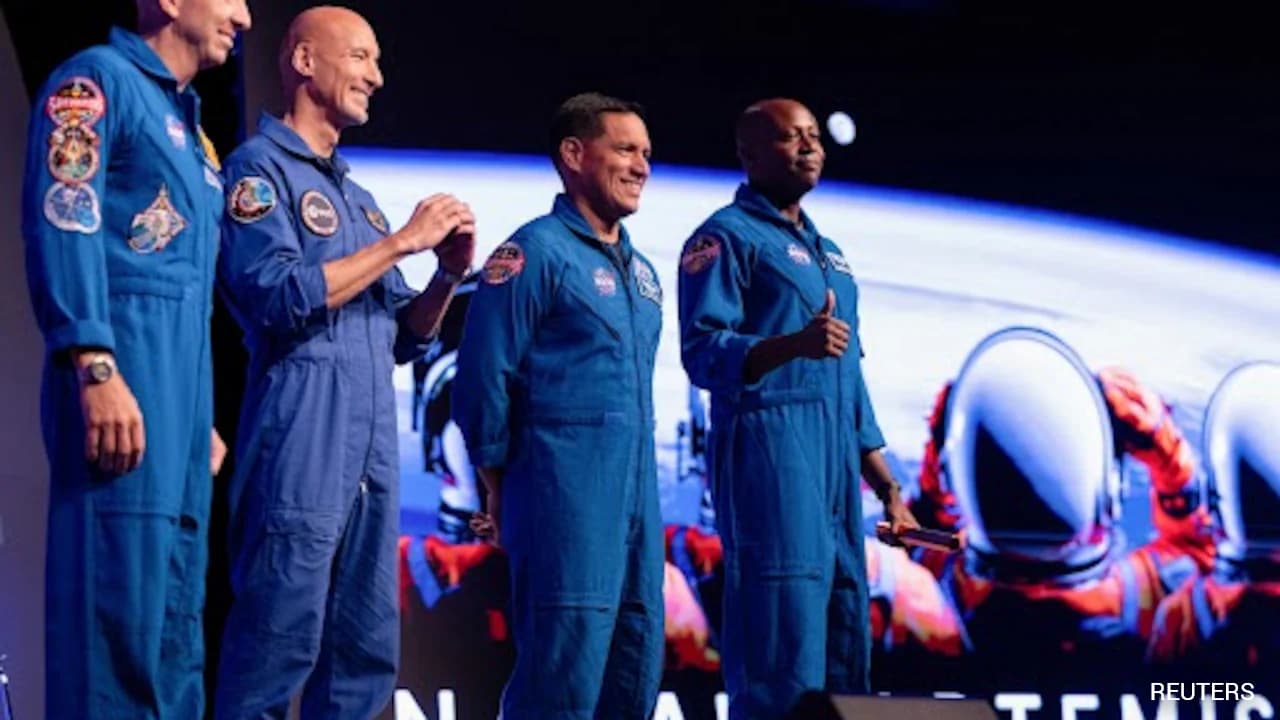
NASA named three U.S. astronauts and one Italian astronaut from the European Space Agency as the crew for Artemis III, scheduled to launch in 2027. The mission will conduct a docking demonstration in Earth's orbit and test moon landers from SpaceX and Blue Origin. The crew includes a veteran test pilot, a record-holder for longest U.S. spaceflight, and a first-time space flyer.
NASA announced the crew for Artemis III, consisting of mission commander Randy Bresnik (58, a retired Marine Corps colonel and test pilot with three prior spaceflights), pilot Luca Parmitano (49, the first European Space Agency astronaut on an Artemis mission), and mission specialists Frank Rubio (50, who holds the record for longest continuous U.S. spaceflight at 371 days) and Andre Douglas (40, making his first spaceflight). The mission, scheduled for 2027 with no specific launch date yet announced, will involve a docking demonstration with three spacecraft in Earth's orbit and will test moon landers developed by SpaceX and Blue Origin. Parmitano's selection marks Italy's involvement in the Artemis program and represents the second non-U.S. citizen on an Artemis mission, following Canadian astronaut Jeremy Hansen on Artemis II.
Limitations & open questions
The article does not specify the exact objectives of the docking demonstration, the timeline for when the mission will actually land on the moon (if at all), or clarify whether Artemis III is the lunar landing mission or a preparatory mission in Earth orbit.
What different sources said
- NDTVCenter
Meet NASA's Artemis III Crew: A Test Pilot, Italian, Record-Holder, First-Timer
Related
Researchers Identify D-Retro-Inverso Peptide Candidates for Treating Cardiac Amyloidosis
Researchers have designed and computationally evaluated four peptide candidates made from D-amino acids that may inhibit the formation of Serum Amyloid A (SAA) fibrils associated with cardiac complications following heart attacks. The study builds on mouse model evidence suggesting SAA aggregates contribute to long-term myocardial infarction complications and may operate similarly in humans. Two candidates, DRI-R5S and DRI-H6A, were identified as particularly promising for potential drug development.
Study Identifies D-Retro-Inverso Peptides as Potential Treatments for Cardiac Amyloidosis
Researchers designed four peptide candidates using D-amino acids to inhibit Serum Amyloid A (SAA) fibril formation, which may contribute to complications following heart attacks. The study, conducted using molecular dynamics simulations in a mouse model, identified two peptides—DRI-R5S and DRI-H6A—as promising drug candidates. This work could lead to new therapeutic approaches for cardiac amyloidosis, a serious post-infarction complication.
Scientists Discover Previously Unknown Branch of Tryptophan Metabolism in Humans
Researchers identified a new enzymatic step in human tryptophan catabolism, showing that the protein ASPDH acts as a 2-aminomuconate reductase to produce a previously unknown amino acid. This discovery fills a gap in the kynurenine pathway, one of the body's major metabolic routes for processing the amino acid tryptophan. The finding expands understanding of human metabolism and may have implications for understanding NAD cofactor production and related metabolic diseases.