Mass Fish Die-Off at Arizona Lake Signals Broader Crisis Threatening US Water Systems
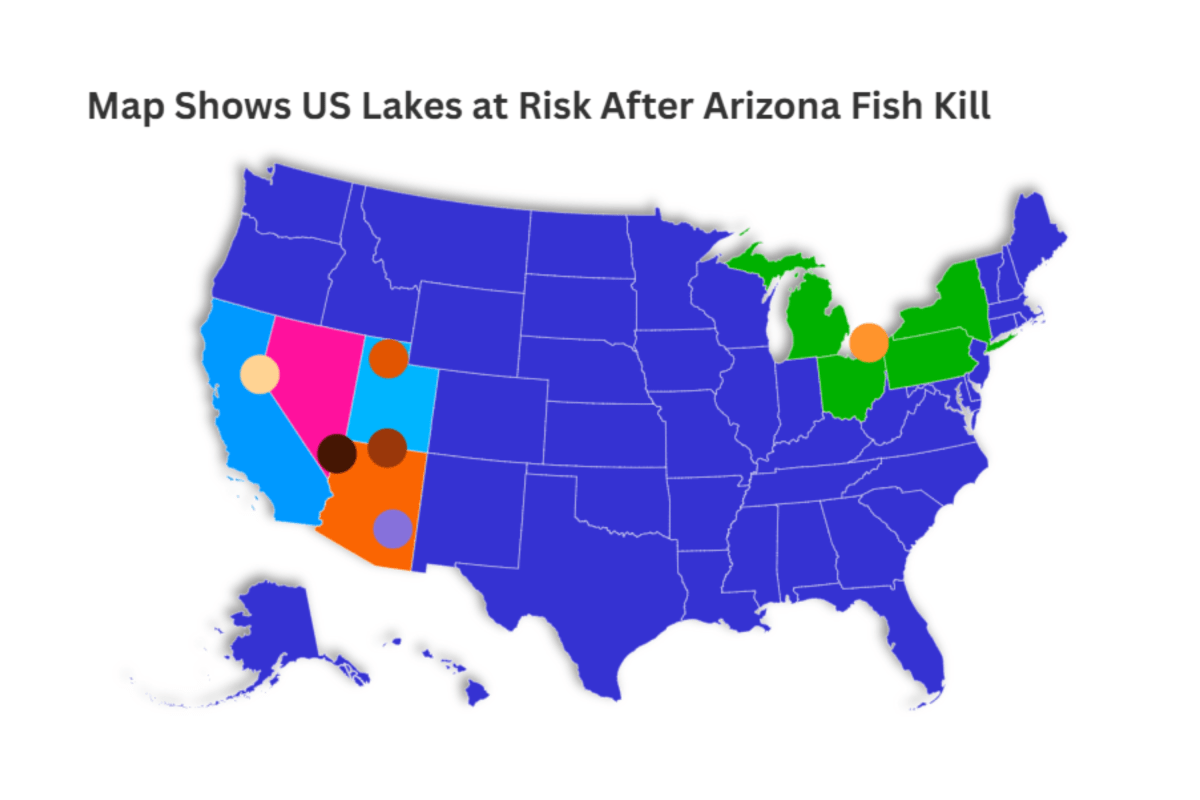
A complete fish kill at Arizona's San Carlos Lake has prompted warnings from scientists that similar ecological collapses could occur across major U.S. water systems due to drought, warming temperatures, and water management pressures. The incident was triggered by prolonged drought followed by rapid water releases that depleted oxygen levels. The event underscores vulnerabilities in critical water infrastructure, particularly in the Colorado River basin, where Lake Mead and Lake Powell face historic strain.
A mass fish die-off at San Carlos Lake in Arizona has eliminated approximately 100 percent of the lake's fish population, according to the San Carlos Recreation and Wildlife Department. The die-off resulted from a combination of prolonged drought followed by rapid water releases from the dam, which created conditions of low water levels, warming temperatures, and oxygen depletion. Scientists and water managers warn that these conditions are increasingly common across major U.S. water systems and could trigger similar ecological collapses elsewhere. The Colorado River basin faces particular risk, with Lake Mead—which supplies water to 40 million people—operating under official shortage conditions and potentially reaching record lows by 2027. Lake Powell is approximately 25 percent full, and experts warn of a potential "system crash" within the Colorado River basin by 2028. Beyond the Colorado River, other lakes including the Great Salt Lake and Lake Erie face distinct but related threats from drought, warming water, and human water use.
What different sources said
- NewsweekCenter
Map Shows US Lakes at Risk After Arizona Fish Kill
Related
Profilin-1 Deficiency Activates Immune Response Against Breast Cancer in Preclinical Study
Researchers found that removing the Profilin-1 protein from breast cancer cells triggers DNA damage and activates an immune pathway called STING, which recruits cancer-fighting T cells and causes tumor regression in mice. The study used CRISPR gene-editing technology to deplete Profilin-1 and observed that the resulting genomic instability paradoxically strengthens anti-tumor immunity. The findings suggest targeting Profilin-1 could be a new strategy to enhance immunotherapy effectiveness in breast cancer.
Computational Study Explores How Magnetic Fields May Affect Tomato Plant Ion Channels
Researchers used molecular dynamics simulations to investigate how static magnetic fields affect the CNGC6 ion channel in tomato plants, finding that magnetic fields may alter the channel's structure in specific ways. The study was motivated by observations that magnetic treatment of tomato seeds appears to speed germination and improve plant development, though the underlying cellular mechanisms remain unclear. The findings provide a computational foundation for future experimental work, though the authors emphasize this is a preliminary exploratory study requiring validation.
New Algorithm Simplifies Evolutionary Network Reconstruction for Hybridized Species
Researchers developed NetCS, a fast algorithm for reconstructing evolutionary networks in hybridized species that avoids expensive computational bottlenecks. The method works well when given accurate intermediate data but reveals that the real challenge in network inference lies in an earlier reconstruction step. This finding could enable phylogenetic analyses of larger datasets while identifying where future improvements are needed.