Longest dinosaur trackway discovered in Oxfordshire quarry with 200 footprints from 166 million years ago
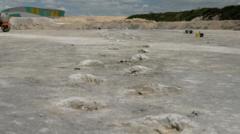
Researchers have identified a 200-footprint dinosaur trackway at Dewars Farm Quarry in Oxfordshire as the longest continuous sauropod trackway ever discovered, dating back 166 million years. The tracks show evidence of multiple sauropods of different sizes and possibly a Megalosaurus predator, preserved in what was once a tropical lagoon environment with shallow inland seas and islands. The discovery provides rare insight into dinosaur behavior and herd dynamics from the Middle Jurassic period.
A 200-footprint dinosaur trackway discovered at Dewars Farm Quarry in Oxfordshire has been confirmed by Oxford University researchers as the longest exposed continuous sauropod trackway in the world. The tracks were made 166 million years ago and include four separate trackways of different-sized sauropods, possibly representing a family herd of varying ages or multiple sauropod species. The site also reveals evidence of a Megalosaurus predator and shows an unusual footprint where a sauropod appears to have paused and leaned on one leg, potentially while being tracked by the predator. The area during the Middle Jurassic period was a tropical environment with shallow inland seas dotted with islands similar to the Bahamas, where these dinosaurs lived. Scientists are working with the quarry operators and Natural England to preserve the site, and believe additional footprints may still be discovered at the location.
What different sources said
- BBC Top StoriesCenter
Dinosaur highway 'longest of its kind in the world'
Related
Profilin-1 Deficiency Activates Immune Response Against Breast Cancer in Preclinical Study
Researchers found that removing the Profilin-1 protein from breast cancer cells triggers DNA damage and activates an immune pathway called STING, which recruits cancer-fighting T cells and causes tumor regression in mice. The study used CRISPR gene-editing technology to deplete Profilin-1 and observed that the resulting genomic instability paradoxically strengthens anti-tumor immunity. The findings suggest targeting Profilin-1 could be a new strategy to enhance immunotherapy effectiveness in breast cancer.
Computational Study Explores How Magnetic Fields May Affect Tomato Plant Ion Channels
Researchers used molecular dynamics simulations to investigate how static magnetic fields affect the CNGC6 ion channel in tomato plants, finding that magnetic fields may alter the channel's structure in specific ways. The study was motivated by observations that magnetic treatment of tomato seeds appears to speed germination and improve plant development, though the underlying cellular mechanisms remain unclear. The findings provide a computational foundation for future experimental work, though the authors emphasize this is a preliminary exploratory study requiring validation.
New Algorithm Simplifies Evolutionary Network Reconstruction for Hybridized Species
Researchers developed NetCS, a fast algorithm for reconstructing evolutionary networks in hybridized species that avoids expensive computational bottlenecks. The method works well when given accurate intermediate data but reveals that the real challenge in network inference lies in an earlier reconstruction step. This finding could enable phylogenetic analyses of larger datasets while identifying where future improvements are needed.