Linafexor: A New Pulsatile FXR Agonist for Bile-Acid-Related Liver Diseases
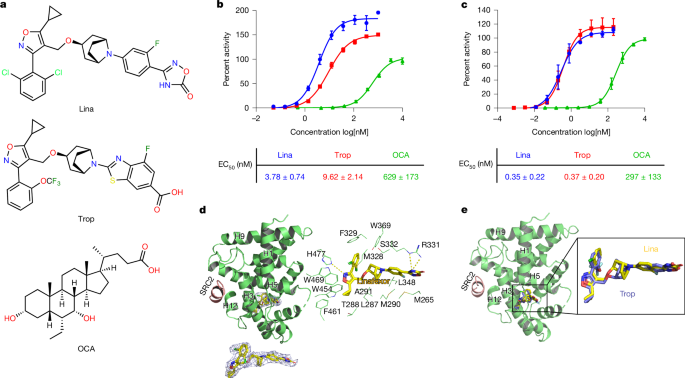
Researchers have developed linafexor, a first-in-class pulsatile farnesoid X receptor (FXR) agonist designed to treat bile-acid-related liver diseases including non-alcoholic fatty liver disease. FXR agonists work by regulating bile acid metabolism and have shown promise in previous clinical trials with other compounds. This advancement could offer a new therapeutic approach for patients with liver conditions currently lacking effective treatments.
Scientists have characterized linafexor, a novel pulsatile FXR agonist that represents a new class of treatment for bile-acid-related liver diseases. The research includes detailed structural analysis, with the crystal structure of the FXR–linafexor complex deposited in the Protein Data Bank, along with transcriptomics data made publicly available. FXR agonists function by modulating bile acid signaling pathways that regulate liver metabolism and inflammation. The work builds on previous clinical experience with other FXR agonists such as tropifexor and obeticholic acid, which demonstrated efficacy in treating non-alcoholic steatohepatitis (NASH). The pulsatile delivery mechanism of linafexor represents a refinement in drug design intended to optimize therapeutic benefit while potentially reducing side effects associated with continuous FXR activation.
Limitations & open questions
The provided text consists primarily of references and data availability statements rather than a complete research article. Key missing information includes: the specific clinical efficacy data for linafexor, comparison of efficacy and safety profiles with existing FXR agonists, the mechanism by which pulsatile delivery improves upon continuous activation, current development stage (preclinical vs. clinical trials), and timeline for potential clinical availability.
What different sources said
- Nature NewsCenter
A first-in-class pulsatile FXR agonist for bile-acid-related liver diseases
Related
Study reveals IDH1 enzyme's role in cardiac metabolic adaptation during cancer-related stress
Researchers discovered that isocitrate dehydrogenase 1 (IDH1) helps the heart adapt to metabolic stress caused by cancer-related mutations through a previously unknown reductive metabolic pathway. The study used stable isotope tracing and genetic knockout models in rat and mouse heart tissue to show that when mitochondrial metabolism is impaired, IDH1 redirects carbon flux toward glutamine-derived citrate formation. This finding expands understanding of how cardiac metabolism responds to oncometabolic stress and may have implications for managing cardiovascular complications in cancer patients.
AI Framework Reveals How β-Arrestin 1 Protein Changes Shape During Activation
Researchers used a transformer-based artificial intelligence model to analyze how the β-arrestin 1 protein's tail region reorganizes when activated by cell surface receptors. The study examined molecular dynamics simulations comparing the protein in resting and active states, uncovering previously unknown conformational changes. This work could improve understanding of how cells regulate signaling pathways involved in numerous physiological and disease processes.
Study Links Pancreatic Cancer Tissue Stiffness to Tumor Progression and Patient Survival
Researchers combined imaging scans and laboratory tissue analysis to show that pancreatic cancer tumors with greater stiffness—driven by dense collagen buildup—correlate with worse patient survival outcomes. The study of nine patients found that magnetic resonance elastography, a non-invasive imaging technique, can detect mechanical properties that reflect underlying tumor biology. These findings suggest that measuring tissue stiffness through imaging could help doctors better characterize pancreatic cancer and guide treatment decisions.