Light-induced quantum friction slows carbon nanotubes in water
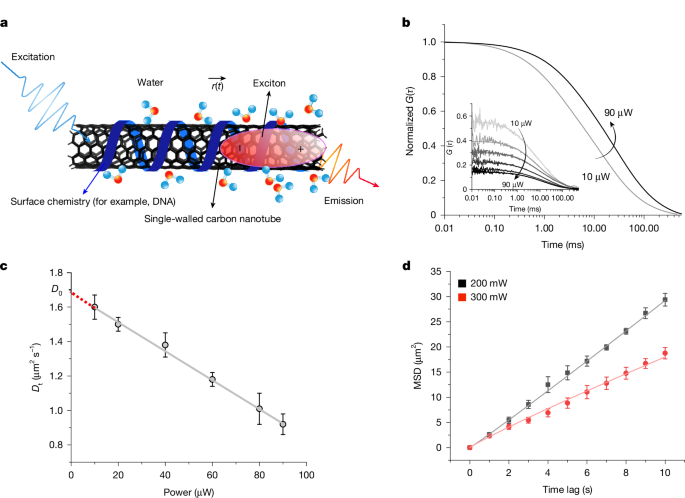
Researchers discovered that carbon nanotubes suspended in water move more slowly when exposed to green light, suggesting a quantum mechanical coupling between excited electrons in the tubes and water molecules. This phenomenon, called quantum friction, involves non-adiabatic interactions between electronic modes in the nanotubes and collective modes of water dipoles. The finding advances understanding of liquid-solid friction at the nanoscale and could have applications in biosensing and nanotechnology.
Scientists studying single-walled carbon nanotubes (SWCNTs) in water observed that light excitation causes the nanotubes to diffuse more slowly through the liquid, a counterintuitive result explained by quantum friction. This type of friction arises from coupling between the electronic excitations (excitons) in the carbon nanotubes and the vibrational modes of water, particularly in the terahertz frequency range. The mechanism involves non-adiabatic interactions that go beyond classical friction models, with the water's librational, intermolecular stretch, and Debye modes playing key roles. Researchers used single-molecule fluorescence measurements, terahertz spectroscopy, and molecular dynamics simulations to characterize the phenomenon. The work builds on prior evidence of anomalous friction at water-carbon interfaces and suggests that quantum effects significantly influence nanoscale hydrodynamics in aqueous environments.
What different sources said
- Nature NewsCenter
Light-induced quantum friction of carbon nanotubes in water
- Nature NewsCenter
Light slows down carbon nanotubes in water
Related
Study reveals IDH1 enzyme's role in cardiac metabolic adaptation during cancer-related stress
Researchers discovered that isocitrate dehydrogenase 1 (IDH1) helps the heart adapt to metabolic stress caused by cancer-related mutations through a previously unknown reductive metabolic pathway. The study used stable isotope tracing and genetic knockout models in rat and mouse heart tissue to show that when mitochondrial metabolism is impaired, IDH1 redirects carbon flux toward glutamine-derived citrate formation. This finding expands understanding of how cardiac metabolism responds to oncometabolic stress and may have implications for managing cardiovascular complications in cancer patients.
AI Framework Reveals How β-Arrestin 1 Protein Changes Shape During Activation
Researchers used a transformer-based artificial intelligence model to analyze how the β-arrestin 1 protein's tail region reorganizes when activated by cell surface receptors. The study examined molecular dynamics simulations comparing the protein in resting and active states, uncovering previously unknown conformational changes. This work could improve understanding of how cells regulate signaling pathways involved in numerous physiological and disease processes.
Study Links Pancreatic Cancer Tissue Stiffness to Tumor Progression and Patient Survival
Researchers combined imaging scans and laboratory tissue analysis to show that pancreatic cancer tumors with greater stiffness—driven by dense collagen buildup—correlate with worse patient survival outcomes. The study of nine patients found that magnetic resonance elastography, a non-invasive imaging technique, can detect mechanical properties that reflect underlying tumor biology. These findings suggest that measuring tissue stiffness through imaging could help doctors better characterize pancreatic cancer and guide treatment decisions.