Kansas boy discovers 15-foot marine reptile fossil from 85 million years ago
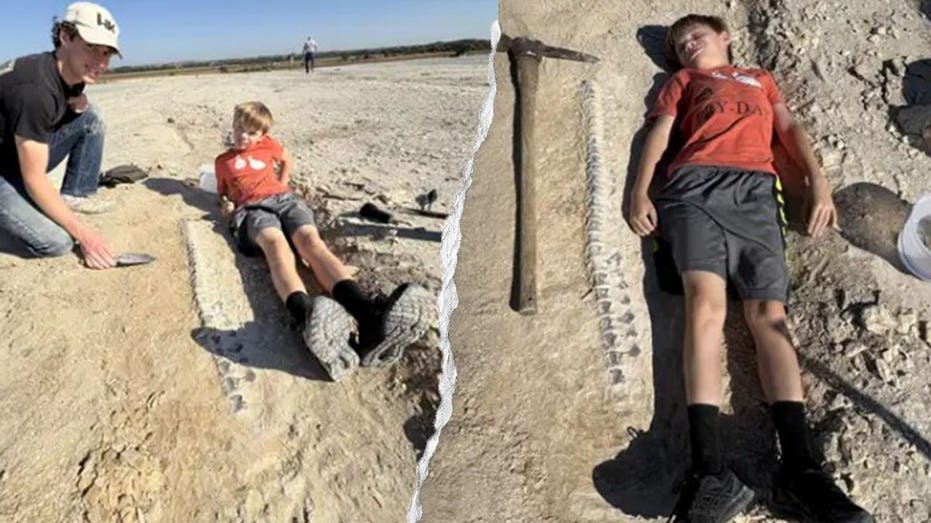
An 11-year-old named Corbin Bullard discovered the remains of a nearly complete tylosaurus, a 15-foot marine reptile, during a geology club field trip near Clearwater, Kansas in September 2025. The fossil dates to the Cretaceous Period approximately 82-87 million years ago and was found in the Smoky Hill Chalk formation, a fossil-rich rock layer. The discovery is notable because it represents a significant find for a young amateur paleontologist and demonstrates how commercial quarrying operations can expose important fossils.
An 11-year-old member of the Sedgwick County 4-H Geology Club discovered the nearly complete skeleton of a tylosaurus, a large marine reptile measuring over 15 feet long, during a September 2025 field trip to a quarry near Clearwater, Kansas. Bullard spotted large vertebrae protruding from rock and, over three subsequent excavation trips with fellow club members, carefully uncovered the specimen including the animal's skull and most of its skeleton. Researchers dated the fossil to the Smoky Hill Chalk formation, placing it within the Cretaceous Period approximately 82-87 million years ago. The discovery occurred at a commercial quarry where routine rock removal regularly exposes fossils. Prior to this find, club members had primarily uncovered smaller specimens such as shark teeth and fish fossils. Now 12 years old, Bullard plans to display the fossil's skull at the Sedgwick County Fair.
What different sources said
- Fox NewsRight
Kansas boy discovers 15-foot marine reptile fossil from 85 million years ago during geology field trip
Related
Profilin-1 Deficiency Activates Immune Response Against Breast Cancer in Preclinical Study
Researchers found that removing the Profilin-1 protein from breast cancer cells triggers DNA damage and activates an immune pathway called STING, which recruits cancer-fighting T cells and causes tumor regression in mice. The study used CRISPR gene-editing technology to deplete Profilin-1 and observed that the resulting genomic instability paradoxically strengthens anti-tumor immunity. The findings suggest targeting Profilin-1 could be a new strategy to enhance immunotherapy effectiveness in breast cancer.
Computational Study Explores How Magnetic Fields May Affect Tomato Plant Ion Channels
Researchers used molecular dynamics simulations to investigate how static magnetic fields affect the CNGC6 ion channel in tomato plants, finding that magnetic fields may alter the channel's structure in specific ways. The study was motivated by observations that magnetic treatment of tomato seeds appears to speed germination and improve plant development, though the underlying cellular mechanisms remain unclear. The findings provide a computational foundation for future experimental work, though the authors emphasize this is a preliminary exploratory study requiring validation.
New Algorithm Simplifies Evolutionary Network Reconstruction for Hybridized Species
Researchers developed NetCS, a fast algorithm for reconstructing evolutionary networks in hybridized species that avoids expensive computational bottlenecks. The method works well when given accurate intermediate data but reveals that the real challenge in network inference lies in an earlier reconstruction step. This finding could enable phylogenetic analyses of larger datasets while identifying where future improvements are needed.