Asymptotic Giant Branch Stars Reveal New Details of Milky Way's Warped Disc
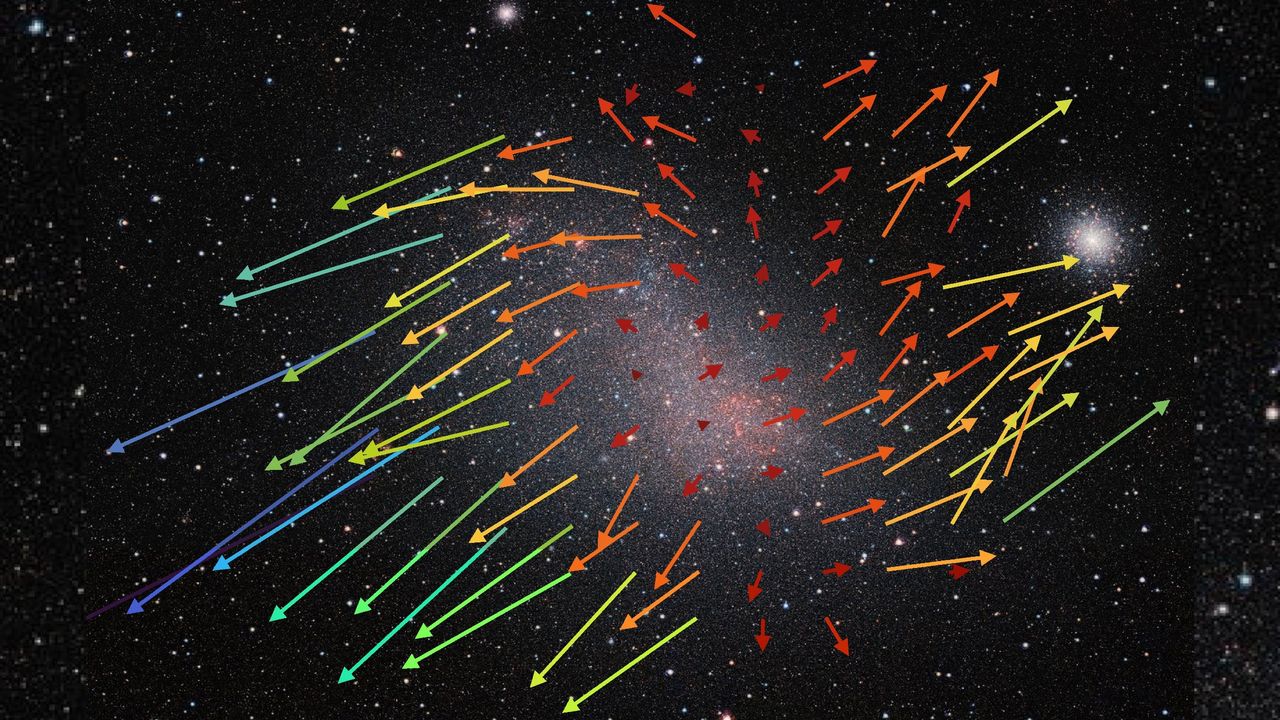
Astronomers have used two populations of asymptotic giant branch (AGB) stars to trace the Milky Way's warped disc with greater precision than before. AGB stars of different masses correspond to different stellar ages, allowing researchers to probe how the warp's amplitude varies over time. The findings offer new constraints on the relationship between stellar age and warp geometry in our galaxy.
A new preprint posted to arXiv presents evidence that asymptotic giant branch (AGB) stars — an evolved phase of low- and intermediate-mass stars — can serve as effective tracers of the Milky Way's well-known disc warp. The study leverages Gaia satellite data covering over one billion stars and focuses on two distinct AGB populations: carbon-rich (C-rich) AGB stars, roughly 1 billion years old with main-sequence masses of 2–2.5 solar masses, and intermediate-mass oxygen-rich (O-rich) AGB stars aged 100–300 million years with masses of 3–5 solar masses. The warp signal detected by the younger O-rich AGB stars is consistent with that previously measured using Cepheid variable stars, which share a similar age range, lending confidence to the method. The more numerous C-rich AGB stars reveal the warp across a wide range of azimuthal angles and appear to reach larger amplitudes than Cepheids in those same directions. Together, the two AGB populations fill an intermediate age gap in existing warp studies, suggesting that warp amplitude may increase with stellar age or population. The results provide a new observational handle on the three-dimensional structure of the Galactic disc and its dependence on stellar demographics.
What's missing
The study is a preprint and has not yet undergone peer review. The relationship between warp amplitude and stellar age remains an open theoretical question that this study constrains observationally but does not explain causally.
What different sources said
- arXiv astro-phCenter
Milky Way's warped disc traced by AGB stars
- Live ScienceCenter
'I was really amazed': On the edge of the Milky Way, a dwarf galaxy is being ripped in half by its big sibling
Related
Gut Bacteria Enzyme Found to Break Down Heat-Processed Food Compounds, Producing Novel Biogenic Amines
Researchers have discovered that an enzyme in common gut bacteria can degrade N-epsilon-carboxymethyllysine (CML), a compound formed during thermal food processing, producing previously unknown biogenic amines. The enzyme, ornithine decarboxylase SpeC from enterobacteria, acts on CML and related modified lysine derivatives through a low-level 'underground' catalytic activity. This finding suggests a previously unrecognized communication axis between thermally processed dietary compounds and gut microbial physiology, with potential implications for host health.
Full-Length Gene Sequencing Reveals Two Distinct Bacterial Communities in Black-Legged Ticks Expanding Into Canada
Researchers used Oxford Nanopore full-length 16S rRNA gene sequencing to characterize the microbiome of Ixodes scapularis black-legged ticks collected in Nova Scotia, Canada, distinguishing between tick-adapted bacteria and environmentally acquired bacteria. The study comes as I. scapularis — the primary vector of Lyme disease — is rapidly expanding northward into Canada due to climate change. The findings suggest that environmentally derived bacteria in tick microbiomes are not mere contamination, which has implications for how tick microbiome data is collected and interpreted across surveillance studies.
Study Identifies Metabolic Link Between Cell Envelope Stress and Biofilm Formation in Bacteria
Researchers have discovered that the metabolite acetyl-CoA directly inhibits enzymes that degrade the bacterial signaling molecule c-di-GMP, connecting cell envelope biosynthesis stress to biofilm formation in Pseudomonas aeruginosa. The study found that sub-inhibitory concentrations of antibiotics targeting early peptidoglycan biosynthesis — but not other antibiotic classes — elevate c-di-GMP levels by reducing phosphodiesterase activity, with acetyl-CoA competing for the enzyme active site. Because the relevant enzyme domain is broadly conserved across bacterial species, this checkpoint mechanism may be widespread and could have implications for understanding antibiotic-induced biofilm responses.