Apple Drops Support for 2022 Apple Watch Models in watchOS 27
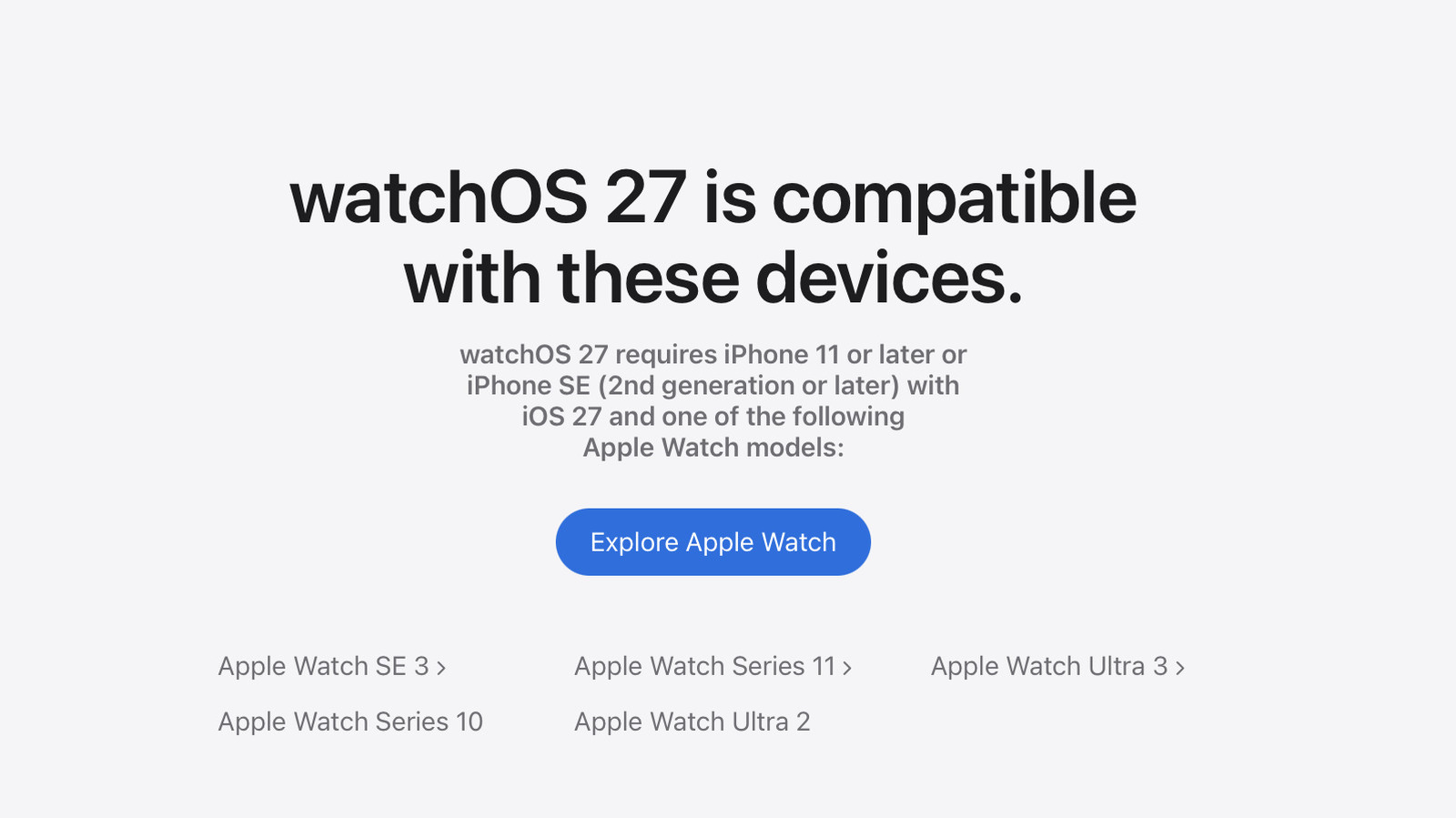
Apple's watchOS 27, announced at WWDC 2026, will drop support for the Apple Watch SE 2, Series 6 through 8, and the original Ultra, while adding AI-powered Siri, a unified Find My app, and new gesture controls. The cutoff appears tied to the S9 chip requirement needed to handle new Apple Intelligence features. The move has frustrated users who paid hundreds of dollars for watches released as recently as 2022, and Apple also quietly removed the long-standing Walkie-Talkie app in the first developer beta.
At WWDC 2026, Apple revealed that watchOS 27 will be limited to the Apple Watch SE 3, Series 9, Series 10, Series 11, Ultra 2, and Ultra 3, dropping support for the SE 2, Series 6, 7, 8, and the original Ultra — all released in 2022 or earlier. Apple's website initially omitted the Series 9 from the compatible list, causing confusion, but the company confirmed to Engadget that the Series 9 is supported; the website listing was expected to be corrected. The likely driver for the tighter hardware cutoff is the S9 chip, which Apple appears to require for its expanded Apple Intelligence and AI Siri features. On the feature side, watchOS 27 introduces a conversational AI Siri with world knowledge and in-app actions, a standalone Siri app showing cross-device conversation history, a unified Find My app replacing three separate apps, an improved Workout Buddy that now functions without a nearby iPhone, a new tap gesture for the Smart Stack, and a more refined Liquid Glass design. Separately, the Walkie-Talkie app — launched in 2018 and largely neglected since — appears to have been quietly removed from the first developer beta, with no official explanation from Apple, though its retirement is widely expected given years of minimal updates and reliability complaints. A public beta is expected in July, with a full release anticipated in the fall alongside new Apple Watch hardware.
What's missing
It is also unclear whether unsupported watch models will continue to receive security patches after watchOS 27 launches.
How coverage differed
Engadget and BGR covered the compatibility changes in a relatively matter-of-fact, feature-focused tone, while the New York Post leaned into user frustration and framed the story around obsolescence and consumer grievance, including Reddit quotes and commentary about Apple's environmental messaging contradictions.
What different sources said
- MacRumorsCenter
Apple Removes Walkie-Talkie From Apple Watch in watchOS 27 Beta
- EngadgetCenter
Apple is dropping support for some pretty modern Watch models
- PhoneArenaCenter
watchOS 27 is removing one of the most fun features from the Apple Watch
- bgr.comCenter
watchOS 27 Adds 5 New Features And Skips 5 Old Models
- TechRadarCenter
‘We’ve used this feature for years’: Apple has ditched a fun Apple Watch feature from watchOS 27 — and some users are missing it already
- New York PostRight
5 Apple products just became obsolete — leaving users without tech support or updates
- 9to5MacCenter
watchOS 27 will add two new apps to your Apple Watch
Related
Samsung Galaxy S25 and S25 FE See Significant Price Cuts
Samsung's Galaxy S25 and Galaxy S25 FE smartphones are currently available at notably reduced prices, with the S25 FE dropping $201 (33%) to $449 on Woot for a limited time. The price reductions come amid a competitive smartphone market and ahead of anticipated future Samsung releases. The discounts make previously premium-priced devices more accessible to budget-conscious consumers.

Anthropic Disables Fable 5 and Mythos 5 AI Models Globally After US Government Export Control Order
Anthropic has suspended all public access to its two most advanced AI models, Fable 5 and Mythos 5, after the US Commerce Department issued an export control directive ordering the company to block foreign nationals from accessing them on national security grounds. The order came just three days after Fable 5's public launch and reportedly stems from government concerns about a potential jailbreak that could enable the models to assist with cyberattacks, though Anthropic says it received only verbal evidence of a narrow, non-universal vulnerability. The shutdown affects all customers globally — including enterprise users and Anthropic employees — and marks a significant escalation of US efforts to restrict foreign access to advanced AI models themselves, rather than just the chips that power them.

Xbox Free Play Days Offers Three Games Free to Play June 11–14
Microsoft's Xbox Free Play Days program is offering Hell Let Loose, State of Decay 2: Juggernaut Edition, and Blasphemous 2 at no cost from June 11 to June 14. Hell Let Loose requires an Xbox Game Pass Ultimate, Premium, or Essential membership, while State of Decay 2 and Blasphemous 2 (via a five-hour timed trial) are accessible to all Xbox console owners. Players who wish to keep any of the games can purchase them at a limited-time discount and retain any achievements earned during the free period.