Amtrak Unveils $7-8 Billion Plan to Redesign Penn Station with Grand Beaux-Arts Architecture
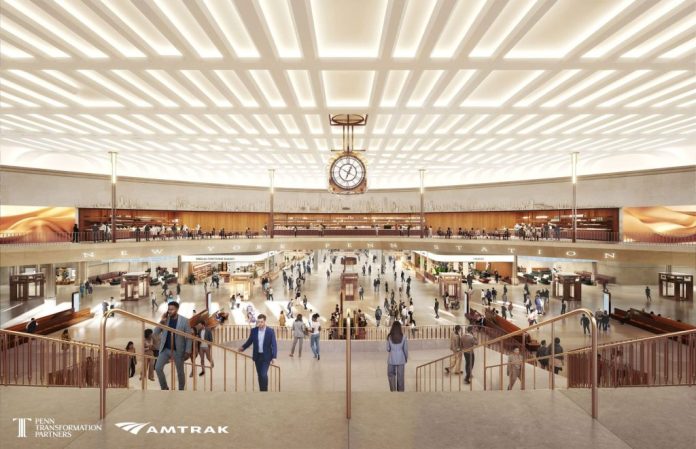
Amtrak and Penn Transformation Partners unveiled renderings for a sweeping $7–8 billion redesign of New York's Penn Station, featuring a grand Eighth Avenue entrance with classical columns, a single-level concourse with ceilings over 50 feet high, and bronze ornamental details. The project, which places Amtrak in sole charge after decades of stalled plans involving multiple agencies, is projected to break ground by end of 2027 and take roughly six years to complete while the station remains operational. The redesign would transform the Western Hemisphere's busiest transit hub, serving over 600,000 daily commuters, though key questions about full through-running capacity, final financing, and the MSG financial agreement remain unresolved.
Renderings released Monday by Amtrak and Penn Transformation Partners show a dramatically reimagined Pennsylvania Station in Manhattan, with a stone facade lined with classical columns on Eighth Avenue, a sunlit single-level concourse replacing the current multi-level maze, coffered ceilings exceeding 50 feet, and ornamental details including a bas-relief city skyline and a large bronze clock. The design draws inspiration from Grand Central Terminal's Beaux-Arts style, Art Deco landmarks like the Empire State Building, and WPA-era federal architecture, aiming to restore civic grandeur lost when the original 1910 station was demolished in 1963 to make way for Madison Square Garden. Madison Square Garden will remain on-site, though an MSG-owned theater directly above the tracks will be razed; developers and MSG owner James Dolan have reached a memorandum of agreement on this point, though financial terms are still being negotiated. The Trump administration transferred oversight of the project from the MTA to Amtrak last year, with officials citing decades of bureaucratic dysfunction and fragmented leadership as the reason for the change, and has committed approximately $243 million toward planning so far, with the bulk of the estimated $7–8 billion to come from federal grants, federal loans, and private financing. Amtrak adviser Andy Byford pledged no fare hikes to fund the project and said the federal funding allocation is expected to be clarified within about six months, while transit advocates have raised concerns about transparency and the risk to existing services. The redesign promises a 165% increase in public space, removal of roughly 100 structural columns to widen platforms, and at least limited train through-running, though full through-running implementation and detailed engineering plans remain to be finalized. Renderings also show a presidential seal bearing Donald Trump's name inside the station, though officials confirmed the building's facade will continue to read 'Pennsylvania Station.'
What's missing
No source provides an independent cost-benefit or ridership capacity analysis from transit engineers outside the project consortium.
How coverage differed
The Washington Examiner and Daily Wire framed the project primarily as a Trump administration achievement and federal intervention success story, heavily quoting officials crediting presidential involvement, while centrist and left-leaning outlets like The Independent, PBS/AP, and Fortune gave more prominence to transit advocate criticism, the unresolved MSG financial terms, and the potential name-change controversy, presenting the project in a more neutral or cautiously skeptical light.
What different sources said
- FortuneCenter
‘I’m not focused on names at all’: Rumors of Trump Station replacing Penn Station in New York batted aside
- BloombergCenter
New York Penn Station Rehab Eyes Billions in Federal Funding
- Daily WireRight
The Transit Hub That Shapes America’s First Impression Is Getting A Reboot
- Washington ExaminerRight
Trump administration casts Penn Station overhaul as blueprint for federal infrastructure revival
- ABC NewsCenter
New York's train station to get $8B remodel with columns, sunlight and Trump's name
- PBS NewsHourLeft
New York's Penn Station to get $8 billion remodel with columns, sunlight and Trump's name
- The IndependentLeft
The station that shamed New York is finally getting an $8bn makeover
- NewsweekCenter
Will Penn Station Redesign Fix America’s Troubled Transit Hub?
Related

CIS Study: Non-Citizen Households Use Welfare at Higher Rates Than U.S.-Born Households in Nearly Every State
A new analysis by the Center for Immigration Studies found that 47% of non-citizen-headed households used at least one means-tested welfare program, compared to 28% of U.S.-born-headed households. The study drew on five years of Census Bureau data and found the gap persisted across nearly every state, with the largest disparities in New York, Massachusetts, and California. The findings reignite a long-running debate over immigration and public benefit usage, though the methodology has been contested by other researchers.

Pilot Killed in Small Plane Crash Near Twin Oaks Airpark in Washington County, Oregon
A small two-seater experimental plane crashed into a grassy field near Twin Oaks Airpark in Hillsboro, Oregon on Friday afternoon, killing its sole occupant. The crash occurred during takeoff and sparked a grass fire that spread to a nearby field before firefighters contained it. The NTSB and FAA are investigating the cause, and flights at the airpark were canceled for the remainder of the day.

Ohio Police Chief Arrested in Florida on 70-Count Child Sex Indictment
Bethel Police Chief Chad Essert, 44, was arrested Tuesday night in Seminole, Florida, following a Clermont County grand jury indictment on 56 counts of sexual battery and 14 counts of unlawful sexual conduct with a minor. The alleged offenses occurred between 2005 and 2010, when Essert was an instructor with the Young Marines program and a teacher at Scarlet Oaks Career Campus in Sharonville, Ohio. If convicted on all counts, Essert faces a maximum of 280 years in prison, and authorities are urging any additional potential victims to come forward.