Advances in Blue Perovskite Light-Emitting Diodes Through Nanocrystal Confinement
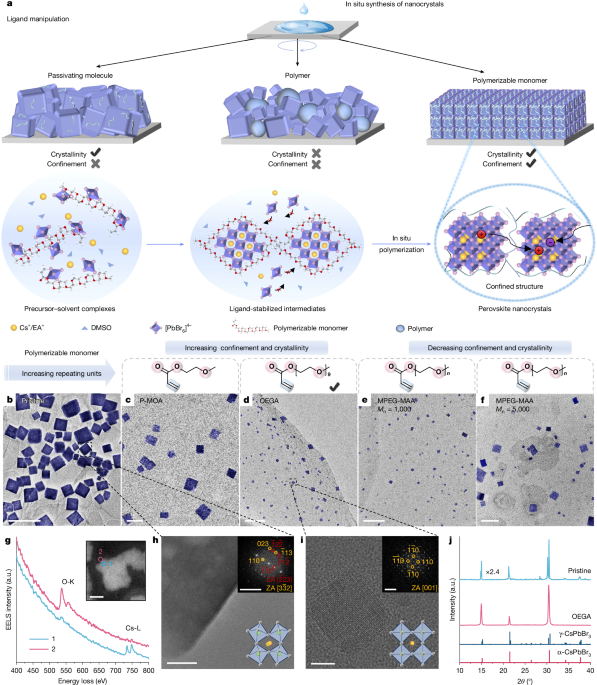
Researchers have achieved significant improvements in blue perovskite light-emitting diodes (LEDs) using in situ nanocrystal confinement techniques, with external quantum efficiencies exceeding 23%. The development builds on recent breakthroughs in reduced-dimensional perovskite materials and defect suppression strategies. These advances are important for next-generation display and lighting applications, as blue perovskite LEDs have historically lagged behind red and green variants in efficiency.
Recent research demonstrates that in situ nanocrystal confinement enables efficient blue perovskite light-emitting diodes, addressing a long-standing challenge in the field. The approach involves controlling the distribution and assembly of perovskite nanocrystals to suppress defects and improve charge transport, with reported external quantum efficiencies exceeding 23% and approaching 30% in some configurations. This builds on complementary advances in thermodynamic crystallization control, ligand chemistry optimization, and solvent engineering that have collectively improved perovskite LED performance across the visible spectrum. The work represents progress toward practical applications in displays and data communications, though challenges around stability and manufacturability remain active areas of investigation. Multiple research groups have contributed to this progress through varied approaches including trifluoroacetate passivation, mixed hole transport layers, and iodine management strategies.
Limitations & open questions
The provided source appears to be a reference list from a Nature article rather than a full article text. Key missing context includes: the specific methodology of the nanocrystal confinement technique, quantitative performance comparisons with competing LED technologies (organic LEDs, quantum-dot LEDs), current limitations in color purity and operational lifetime, commercialization timeline, and cost considerations for manufacturing at scale.
What different sources said
- Nature NewsCenter
In situ nanocrystal confinement for efficient blue perovskite LEDs
Related
Study reveals IDH1 enzyme's role in cardiac metabolic adaptation during cancer-related stress
Researchers discovered that isocitrate dehydrogenase 1 (IDH1) helps the heart adapt to metabolic stress caused by cancer-related mutations through a previously unknown reductive metabolic pathway. The study used stable isotope tracing and genetic knockout models in rat and mouse heart tissue to show that when mitochondrial metabolism is impaired, IDH1 redirects carbon flux toward glutamine-derived citrate formation. This finding expands understanding of how cardiac metabolism responds to oncometabolic stress and may have implications for managing cardiovascular complications in cancer patients.
AI Framework Reveals How β-Arrestin 1 Protein Changes Shape During Activation
Researchers used a transformer-based artificial intelligence model to analyze how the β-arrestin 1 protein's tail region reorganizes when activated by cell surface receptors. The study examined molecular dynamics simulations comparing the protein in resting and active states, uncovering previously unknown conformational changes. This work could improve understanding of how cells regulate signaling pathways involved in numerous physiological and disease processes.
Study Links Pancreatic Cancer Tissue Stiffness to Tumor Progression and Patient Survival
Researchers combined imaging scans and laboratory tissue analysis to show that pancreatic cancer tumors with greater stiffness—driven by dense collagen buildup—correlate with worse patient survival outcomes. The study of nine patients found that magnetic resonance elastography, a non-invasive imaging technique, can detect mechanical properties that reflect underlying tumor biology. These findings suggest that measuring tissue stiffness through imaging could help doctors better characterize pancreatic cancer and guide treatment decisions.