Actor Sivakumar Reflects on Bharathiraja's Revolutionary Portrayal of Tamil Nadu Village Life

Actor Sivakumar has praised filmmaker Bharathiraja as Tamil cinema's greatest director for authentically depicting rural village life on screen. Bharathiraja was the first to break from Tamil cinema's tradition of focusing on upper-class urban narratives and Puranic adaptations, instead bringing the villages of southern Tamil Nadu to life. His work opened doors for rural artists and created an enduring legacy that shaped generations of filmmakers and performers.
In an interview with The Hindu, actor Sivakumar has lauded filmmaker Bharathiraja as a transformative figure in Tamil cinema who revolutionized how village life was portrayed on screen. Sivakumar argues that while earlier Tamil films focused on Puranic stories, upper-class narratives, or urban middle-class life—even socially conscious films like Parasakthi—it was Bharathiraja who first authentically captured the dusty landscapes, quiet beauty, and profound humanity of rural existence in southern Tamil Nadu. Through films such as 16 Vayathinile, Mudhal Mariyadhai, and Karuthamma, Bharathiraja gave voice to ordinary people and their stories, creating what Sivakumar describes as a monumental revolution. This shift not only elevated Bharathiraja himself but opened pathways for rural artists like composer Ilaiyaraaja and lyricist Vairamuthu to reach prominence. Sivakumar emphasizes that Bharathiraja's enduring impact lies in his ability to emotionally connect audiences to rural narratives by tapping into a universal village consciousness, securing his place as an immortal figure in cinema history.
What different sources said
- The HinduCenter
It is only through Bharathiraja’s films that we can see what the villages of Tamil Nadu were once like: Actor Sivakumar
Related

Documentary 'Hollywood Does Abortion' Claims Entertainment Industry Stigmatized Abortion Through Misleading Portrayals
A new documentary premiered at the Tribeca Film Festival arguing that Hollywood films and television shows have historically depicted abortion in a stigmatized and inaccurate manner, from the 1970s to recent years. The filmmakers contend that portrayals often featured false medical complications, miscarriages that prevented characters from making abortion decisions, or exaggerated post-abortion regret. The documentary's claims have drawn responses from both abortion-rights and pro-life advocates, with disagreement over the accuracy of abortion's depiction in media and its real-world consequences.

Richmond's 2009 Exhaustive Coaching Search: A Model for AFL Recruitment
An opinion piece examines Richmond's comprehensive two-stage coaching search process in 2009 that ultimately selected Damien Hardwick, who led the club to three premierships in four years. The process involved eight initial candidates and a rigorous evaluation of coaching philosophies, tactical knowledge, and team-building approaches. The article argues the process succeeded not only in selecting the right coach but in identifying a strong pool of candidates who collectively became successful AFL coaches.
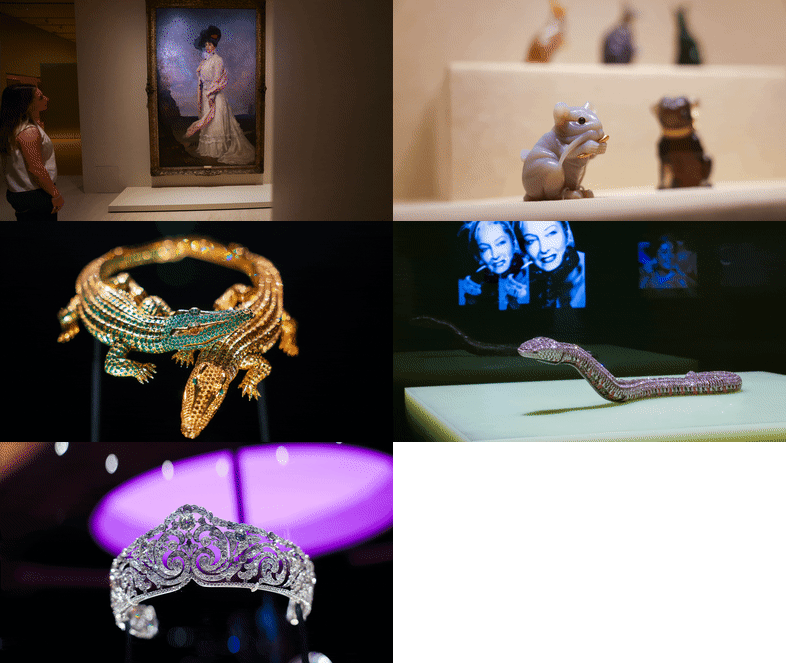
NGV's Cartier Exhibition Showcases Luxury Craftsmanship Amid Questions About Brand-Focused Museum Programming
The National Gallery of Victoria has opened a major Cartier jewelry exhibition featuring hundreds of pieces spanning over a century, originated from London's Victoria & Albert Museum. The show displays exceptional craftsmanship and historical context tracing the brand's evolution from a family business founded in 1847 through its association with royalty, industrialists, and celebrities. The exhibition raises ongoing questions about whether major cultural institutions should dedicate significant space to luxury brand showcases rather than art-focused programming.