2026 World Cup Group Stage Preview: Belgium, Spain, and France Positioned as Group Favorites

The Sydney Morning Herald has published part two of its group-by-group guide to the 2026 FIFA World Cup, covering Groups G, H, and I with analysis of favorites and contenders. Belgium, Spain, and France are identified as the respective group favorites, with Spain and France also mentioned as overall tournament favorites. The expanded 48-team format will see the top two teams from each of 12 groups plus the eight best third-place finishers advance to a round of 32.
The preview covers three World Cup groups scheduled for the 2026 tournament. In Group G, Belgium is favored despite their aging squad, with Egypt positioned as a strong challenger following an undefeated qualifying campaign and Africa Cup of Nations semi-final appearance. Group G also features Iran, competing in the host nation amid ongoing regional conflict, and New Zealand returning to the finals for the first time since 2010. Group H features Spain as the clear favorite following their Euro 2024 championship, with Uruguay expected to challenge them, while Saudi Arabia and Cape Verde are positioned as unlikely contenders. Group I features France, described as not only likely to top the group but also among the tournament favorites overall. The analysis emphasizes Spain and France as overall tournament favorites alongside reigning champions Argentina.
What's missing
The article does not provide complete rosters or detailed player analyses for all teams mentioned, nor does it cover all 12 groups comprehensively (only Groups G, H, and I are analyzed in this installment). The specific composition of Group I beyond France is not detailed in the provided excerpt.
What different sources said
- Sydney Morning HeraldCenter
Your group-by-group guide to the 2026 World Cup: part two
Related

Documentary 'Hollywood Does Abortion' Claims Entertainment Industry Stigmatized Abortion Through Misleading Portrayals
A new documentary premiered at the Tribeca Film Festival arguing that Hollywood films and television shows have historically depicted abortion in a stigmatized and inaccurate manner, from the 1970s to recent years. The filmmakers contend that portrayals often featured false medical complications, miscarriages that prevented characters from making abortion decisions, or exaggerated post-abortion regret. The documentary's claims have drawn responses from both abortion-rights and pro-life advocates, with disagreement over the accuracy of abortion's depiction in media and its real-world consequences.

Richmond's 2009 Exhaustive Coaching Search: A Model for AFL Recruitment
An opinion piece examines Richmond's comprehensive two-stage coaching search process in 2009 that ultimately selected Damien Hardwick, who led the club to three premierships in four years. The process involved eight initial candidates and a rigorous evaluation of coaching philosophies, tactical knowledge, and team-building approaches. The article argues the process succeeded not only in selecting the right coach but in identifying a strong pool of candidates who collectively became successful AFL coaches.
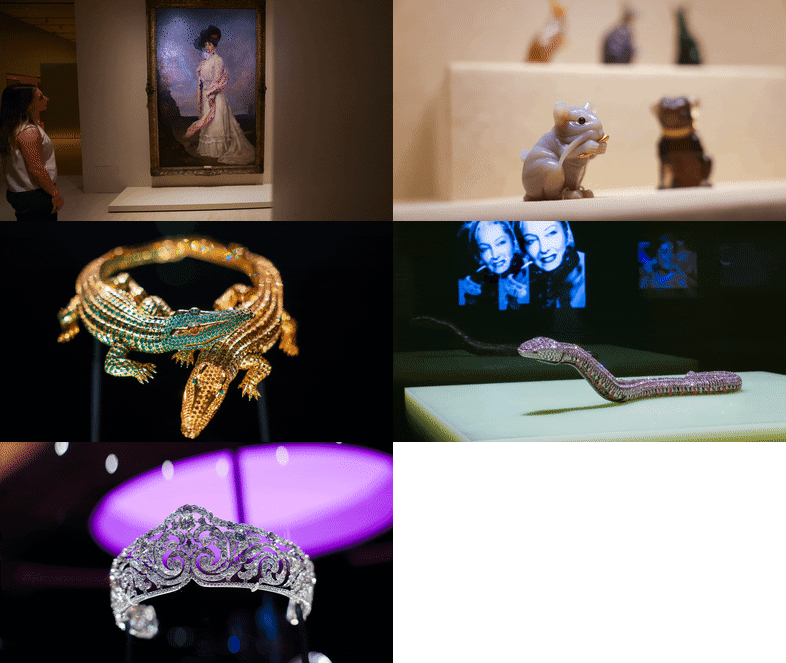
NGV's Cartier Exhibition Showcases Luxury Craftsmanship Amid Questions About Brand-Focused Museum Programming
The National Gallery of Victoria has opened a major Cartier jewelry exhibition featuring hundreds of pieces spanning over a century, originated from London's Victoria & Albert Museum. The show displays exceptional craftsmanship and historical context tracing the brand's evolution from a family business founded in 1847 through its association with royalty, industrialists, and celebrities. The exhibition raises ongoing questions about whether major cultural institutions should dedicate significant space to luxury brand showcases rather than art-focused programming.